
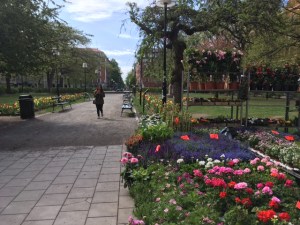
Tuesday evening, May 16, I arrived in Stockholm after a restful five hours on a high-speed train hurtling across the Swedish countryside. The fields were just beginning to be green and yellow with planted crops; I stared and the fields and woods and compact farmhouses. Did I really just land in Europe the day before? From Stockholm’s central station I found the correct commuter subway to carry me to the neighborhood of Mariaberget, including the charming Mariatorget, a park and square in the Sodermalm district, to locate my next bedroom in a private home. The quiet neighborhood is a few minutes’ ride south from central Stockholm, and the apartment building is a few blocks hike from the Mariatorget subway – “tunnelbana” – station. Ah, but again, the last blocks involve climbing up a steep rock-cobbled lane to an obscure sidestreet; and again, multiple conversations with strangers to locate the spot.
A historical note: this park was constructed in the 18th century and originally named after King Adolphus Frederik, but renamed in the mid-20th century after the nearby Kyrka (Church) of Maria Magdalena.
I was met at door, just off the cobbled lane, by an older lady hobbling on an aluminum cane. In much detail, she carefully showed me around her modest apartment; the entry opened into her kitchen, with steep stairs leading from there to the bathroom, and a shorter set of stairs leading to her (sunken?) living room and an adjoining bedroom. The bedroom was mine; I slowly put it together that when guest occupied the bedroom, the host slept on the sofa in the living room, and the guest needed to walk past her and up the stairs and then down a steep stairway to use the bathroom. Oh my. When you are my advanced age, access to the bathroom in the night is a matter of critical logistics.
My host recounted to me the reason for her struggles with walking: she had a hip-replacement done, and the artificial ball had popped out of its socket twice already in about a month. She had an appointment soon to evaluate the need for changing the hardware. I shared that I also had hip replacement surgery a couple years past; happily, mine had not failed.
After briefly but gladly placing my bags in the bedroom, and with detailed and repeated instructions on use of the dual locks on the heavy entrance door, I headed out into the cool evening to search for a restaurant and roam the environs. In May, daylight begins at 4AM and lasts until about 10PM at this latitude, allowing long night-time walks in clear and pale light. The main road in the area is Hornsgatan, and it is lined with cafes and restaurants. I landed in one, and enjoyed a fine pasta; I learned throughout Scandinavia that it was much more likely to find sushi, kebab, pizza and pasta restaurants than one serving “typical” Swedish or Finnish or Estonian dishes.
My first mission on the next day, Wednesday, was to buy the necessary adapter for my charger plugs to work in Scandinavia; my phone and tablet were dying. With the help of my apartment host, I located a little electronics store on Hornsgatan that sold the correct instrument. When reviewing the printed receipt, I laughed and remarked upon the inclusion of 25% sales tax. When the storekeeper learned that sales tax was generally between five and seven percent in the USA, he first remarked: “I should move to America, I could sell so much more with only seven percent sales tax.” But then his eyes widened with realization: “But you have to pay for medical care, and education, don’t you?”
I acknowledged the cost of medical care, but did not correct him about our public education. I pictured all the private schools, often “Christian,” where the wealthy class in the USA sent their children, but chose not to get in that discussion with this happy storekeeper. I was ready to wander the streets of central Stockholm.
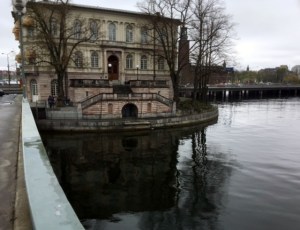
My bedroom host had urged me to visit the “Vasa Museum,” featuring a reconstructed 17th-century sailing ship housed on the island of Djurgarden. But, from the T-bana station in central Stockholm, my feet carried me across one of the many bridges to the island of Gamla Stan, the original “old town” of Stockholm. I stared at the massive Royal Palace and the ornate Swedish Parliament buildings, but was not greatly moved to tour those heavy stone monuments to state power past and present. Walking over one of Stockholm’s many bridges – the city is built on 14 islands – I was fascinated with a massive stone mansion on a small nearby island. It is called Stromsborg, apparently built by a wealthy merchant in the 18th century. It currently houses the offices of IDEA, an international institute to promote democratic elections.
After wandering through Gamla Stan then over bridges to Djurgarden, a park-filled island, I finally encountered the Vasa Museum, masts poking out of its roof. But I was immediately put off by the flock of tour buses near the place, and was more fascinated by the massive dark building nearby, housing the Nordic Museum. It seemed far less attended. But I chose to just wander the grounds and watch the people; the late afternoon was cool and gray, my feet were weary, and I headed back to the T-bana and Mariatorget. As noted in a later blog, I returned in a few days to visit the Nordic. Stopping by the apartment, my host, apparently a controlling person in her solitude, seemed very upset that I had not been inspired to tour the Vasa Museum. “But it is the best place to get a sense of Sweden’s glorious maritime history!” Chastised, I headed out for the clarity of the surrounding streets and the quiet solace of the same restaurant I had found the night before. Mariaberget, for the moment, was my neighborhood; in the dying light, I found a cobbled walkway to a bluff overlooking the water and central Stockholm.
Scribbling my end-of-day notes in the moleskine journal, I mused on the ability of the traveler to capture intuitions about national and cultural cultures, through brief and random encounters. I surmised that, being alert for signals in a strange place, you may be more receptive and perceptive when first exposed to the lives of others. You are on alert, watching the myriad details of movements and gestures; this watchfulness may fade with habitual exposure. I brashly meditated on the character differences of Danes and Swedes, and their shared trait of living in affluent welfare states while seeming to honor the royal traditions of ancient monarchies. A fan of Henning Mankel’s work, I saw more social anxiety among the Swedes. There did seem to be more ragged homeless folk on Stockholm streets. As a healthy older male, I pondered the prevalence of tall, proud and pale-skinned women in all Scandinavian countries; that required no deep intuition.
Thursday morning, May 18, was planned as a travel day: subway and bus to the airport for a short flight to Helsinki. But a nasty surprise awaited. Near 7 AM, I was awakened in my Mariaberget bedroom by moans and yelps of OY-OY-OY, lasting for several minutes, then a pause, then the same sounds again. I lay there for several moments, clearing my head, trying to understand what was happening. Finally I leapt up and headed toward the door to the living room (my host’s bedroom when guests were present), fearing what I would encounter on the other side.
I quickly determined that the poor lady’s artifical hip joint had come undone, again, and she was frozen in a half-standing half-crouching stance, resting all of her weight on one leg and two crutches that she gripped fiercely. Ironically, as she had explained the previous evening, she had a morning appointment with a different surgeon to assess the need to replace the joint. We managed to reach the emergency service and call for an ambulance; she seemed to have a lengthy conversation in Swedish with the operator about her situation and location. The wait for the ambulance felt like 30 to 45 minutes; in the meantime, my poor host directed me to perform a long list of tasks: wiping the ever-dripping sweat from her brow, adjusting her trembling grip on the crutches, fetching a variety of items to pack in a small bag for the hospital stay. The lady is a detailed planner, even in dire straits. She also had me help her take some meds, three small capsules in a foil sheet. I think it was an over-the-counter pain suppressant.
At last the ambulance arrived on the cobbled street below our lane — they could not directly pull up in front of our entrance but had to climb some concrete steps — and two ladies climbed out, looking around. I stepped out the front door and led them into the apartment. I then assisted the rescue women, for what seemed like another hour, to maneuver my host onto a stretcher and up and out and down to the ambulance. Ampules of morphine were administered, and slow, small movements were required in order not to hurt her more. Meanwhile my host, through all the pain and sweat, kept firing off instructions to the very capable ladies and to me; she wanted to be sure I closed up the house correctly. The rescuers and I silently rolled our eyes at each other, acknowledging the endless instructions. When my poor ‘landlady’ was finally rolled onto the ambulance, she wept uncontrollably, with a combination of frustration, pain, and embarrassment. She who needed control had lost it all.
I selfishly enjoyed the silence and calm in the house as I prepared my self and my bags to leave the apartment and lock it up as my host instructed. Walking toward the subway station, through Maria’s Park, I breathed deeply and thankfully. The placid picture of flowers in Mariatorget, at the head of this chapter, was taken that morning as I left.

 Following the Spirit