
While planning this 2017 ScanEst journey, I scrutinized city maps to locate the best public transit routes from point of landing to temporary lodging. Typically, the lodging sites – such as AirBnb or Booking – have brief guides for traveling to your chosen room or apartment. But I also found that each city had online guides to its transit system. Somehow, the public transit directions to my apartment in Helsinki, on a street named Laivanvarustajankatu, seemed complex and conflicting from the online sources. The host/owner’s directions were not much better. But I enjoyed working on the multisyllabic pronunciation of that street, or -katu.
But when I landed at Helsinki’s airport midafternoon on Thursday, 18 May, the mystery was dispelled and the answer was simple. When I bought a few Euro at the Monex counter – yes, I was away from national Krone and Krona to the Euro – I told her I needed to get to the central Metro station in a district called Hakaniemi, famed for its old market building. From there I was fairly confident of the correct tram to take. She promptly directed me to an expansive yard of bus stops just a short walk from the airport building, and to a bus #215. This is a local bus, but I appreciated the slow journey through orderly suburban neighborhoods, with schoolchildren hopping on and off to get to their colorfully-painted homes. I was once again on alert, absorbing all I could of the rhythms of speech and lifestyle of another country, under the bright Nordic sky.
I traversed the city from the far north side to the south, to a district called Ullanlinna well to the south, close to the shore of the Baltic, and near the peninsula called Katajanokka, where I would take a ferry to Tallinn in about 48 hours. I changed from Bus 215 to Tram 3 at Hakaniemi station, and asked the tram operator to advise me when to get off near an R-Kioski on Tehtaankatu, a couple of blocks from my reserved apartment. After winding through old city streets for about ten minutes, we arrived at the stop. R-Kioski’s are a Finnish version of Seven-Eleven, complete with rotisserie hot dogs and cold cases of soda and water. My landlady/host had directed me, by email, to pick up my keys to the apartment at that store. After showing ID, the clerk handed me an envelope with the keys; when I asked him to steer me to Laivanvarustajankatu, he shook his head and said: “Only give you keys; I cannot give you directions.” Service not included. Convenience store clerks all get the same training.
I felt great relief when I arrived at my apartment, on the fourth floor of a heavy stone and concrete apartment building. I was nearing my main objective of the trip, Estonia; I had navigated the public transit system of one more Scandinavian city; and I was in a private apartment with its own kitchen and bath facilities, in contrast with borrowed bedrooms of shared apartments. I looked forward to spending a relaxing day in Helsinki the next day, then finding my Tallinn ferry on Saturday 20 May.
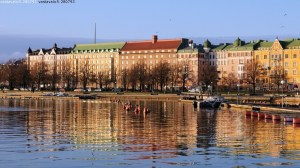
After nursing and wrapping a sore toe – thanks to those hiking boots I had bought only a couple weeks before this trip – I ventured out into another brisk and bright Nordic evening. I first walked a block to a long and broad promenade and park along the water, which borders a small port area called Merisatama on the Gulf of Finland. This is the Nordic life at its best: residents walking and running along the seaside in the long evening light, gazing toward the sea that gave the city its purpose and life. The promenade curves into a vast, rolling park called Kaivopuisto, or Kaivari, that frequently serves as the site for large public celebrations. Bordered on the south by the sea, the park’s northern border is graced by grand residences of the ambassadors of several countries, including the USA. Leaping, dashing pets and baby strollers seemed everywhere. A seaside view of the neighborhood heads this entry.
I then headed a few blocks inland in search of a restaurant in the neighborhood; city exploration would wait for the morning. As I noted before, the most popular neighborhood restaurants feature imported cuisine with local ingredients. I first encountered a sushi restaurant within a block of my apartment; at first avoiding the simple solution, I wandered – or limped – several blocks around the area, seeking something perhaps a bit more ‘authentic.’ I rejected several as appearing too upscale or the opposite, too rough. The evening was maturing, and I was hungry. I circled back around the sushi place, called Sushi ‘n’ Roll, noted the steady flow of patrons, and entered. Clean and airy and lit through large windows to the evening sky, I immediately was comfortable. I lingered over sashimi and seaweed, taking in the upscale neighborhood clientele.
Upon paying, I received a lesson in Scandinavian wage economics. I paid with a plastic card (chip-embedded), as is the merchant preference throughout the region, then fumbled for appropriate Euro change to leave a tip. I apologetically asked to break a too-large Euro bill. The young, dark-haired waitress volunteered: “Please do not worry about leaving a tip. It is not mandatory here. In Finland we are paid enough to live, so I really don’t need something extra.” She paused, as I absorbed this surprising message. “Don’t tip just because you have to, only if you truly liked the food and the service.”
I first responded with my corny Yankee humor, reaching out my hand: “Oh, OK, then give my back my (5-Euro) tip.” I smiled broadly, she laughed nervously, I withdrew my hand and thanked her for the service and the explanation. After making the (unnecessary) explanation of the opposite restaurant economics in the USA, I retreat to the streets of Ulanlinna, Helsinki.
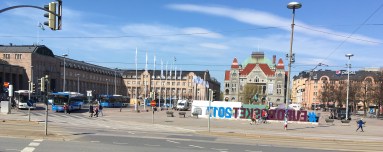
On my one full day in Helsinki, Friday the 19th, I elected to focus on one main objective, visiting the Ateneum art museum, located on the main square, Rautatientori, near the old, hulking central RR station. The tram from “my” neighborhood stopped on the square, so wandering was minimized. The museum, part of the Finnish National Gallery organization, was featuring a large homage to “Alvar Aalto, Art and the Modern Form.” It also featured a longer-running exhibit entitled “Stories of Finnish Art,” displaying the extensive holdings of the Ateneum, both national and international, covering works from the nineteenth and twentieth centuries.
Aalvar Aalto, born at the end of the nineteenth century and working in the twentieth century until his death in 1976, was a dynamic polymath who refused to stick to his core skills in architecture and design. He and his wife, Aino Marsio, as professional partners were initially influenced by classic architecture in Italy, but grew to be leaders of the “modernist” and “functional” design movements of the twentieth century. He helped oversee the striking design of the Finnish Pavilion at the 1939 New York World’s Fair, whose undulating wooden wall Aalto compared with the Northern Lights. Working on the total environment of buildings they designed, Aino and Aalvar oversaw not only outer structure but lighting, furniture, and textiles within their buildings. They were also friends of and collaborators with artists Fernand Leger and Alexander Calder, a few of whose works are also on display in this tribute.
Reaching my limit of absorbing new information, I moved more rapidly through the Ateneum’s other collections. It was fascinating, though, to follow the evolution of Finnish art through the 1800’s and into the cultural and political upheavals of the 1900’s, through realistic depictions of the native Finnish countryside to abstract and symbolist paintings influenced by Parisian and Roman movements. Here I first learned, through visual depictions, of the ancient oral epic of the Kalevala, a Finnish and Karelian equivalent of the Iliad or Beowulf. How few Americans are aware of this work, so central to Finland’s sense of national identity.
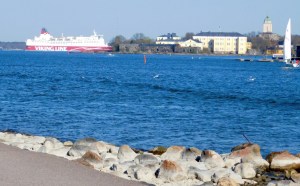
Mid-afternoon, I stepped out into the sunlight on the square, and walked about in search of a cafe with a view of the bustle. Given the chill air, I enjoyed a seafood soup at a rough wooden table looking out on a terrace full of students enjoying the sunlight. I then followed my feet back to the tram to carry me “home” to the Ulanlinna apartment and the seaside promenade. Approaching late afternoon on a Friday, a large cafe and terrace along the seaside was filling up with young professionals celebrating the end of a work week and the late arrival of warm sunshine. The tables were soon covered with wine and beer glasses wrapped in laughter. I climbed the steep hill in the center of the Kaivopuisto park, and captured this image of a ferry headed south into the Gulf of Finland and the Baltic beyond. I was excited to see a vessel like I would board the following morning.
 Following the Spirit