

After all the planning and anticipation, the trip from Helsinki to Tallinn seemed routine that Saturday, May 20. Two different tram rides, and a few blocks walking, and I arrived at the ferry terminal on Katajanokka peninsula in Helsinki. As I observed passengers gathering in the terminal and then boarding the multi-deck ship, I realized that this journey was a routine commute for many Finns. An early-afternoon sailing for a two-hour jaunt across a narrow portion of the Baltic, it seemed that all of Helsinki was starved, as they rushed the dining area before the craft had left the port. Concerned about possible seasickness, I went directly to a seat. But the sea was smooth and the voyage uneventful. A couple rows in front of me, a rangy young lady laden with a bag full of tennis rackets and accompanied by an equally-athletic man led me to imagine that she was one of the aspiring tennis pros of the Baltic States who are currently breaking into the majors. But I was not bold enough to ask her, not wanting to be labeled the dumb American tourist that I was. (The subsequent 2017 women’s champion at Roland Garros was Jelena Ostapenko, from the Estonian neighbor Latvia.)
The luck of the traveler did not seem to be present upon landing in the port of Tallinn. I walked away from the terminal in record heat, approaching 80 degrees F, or 26 C, where the average for May is usually 18 C, or 64 F. A couple of days before, Swedes and Finns were celebrating the advent of 20 C temperature. I found a tram stop in the nearby highway outside the Old Town, but determined that the line that stopped there did not head toward my destination, an old house on a little street named Peeter Suda. I decided to walk in the general direction (south) that maps had indicated, and ask directions. I repeatedly stopped and asked directions; many helpful people tried to steer me in the correct general direction, but most had no idea where P. Suda lay. I continued to disdain the the idea of taking a taxi, and plunged into the winding streets of Old Town, stumbling over uneven paving stones with my roller bag in tow, weighted down by my loaded backpack. The streets were lined with cafes crowded with merry Sunday tourists – many likely off the boat from Finland – as I struggled onward. Someone directed me to a main road passing the eastern edge of Old Town, named Parnu Maantee – Parnu Road. I reached that busy modern street, and proceeded to turn the wrong way, perhaps a hundred meters from my street.
One and a half hours after landing at the port, and circling the neighborhood a couple of times, I found the old three-story house, on shaded P. Suda and just off of Parnu Mnt., and climbed the creaking wooden steps to the third floor. There was my host, a bright and energetic lady, concerned but glad to see me arrive. I was weary and warm, but home. My host graciously showed me the main features of the place, including the marvelous automatic espresso machine. She briefly explained the history of this family home; her grandmother as a young girl had to flee the house in fear of Nazi or Soviet bombardment during WWII. The wooden structure survived and the interior seems artfully remodeled. When I shared my interest in taking day trips outside of Tallinn, my host recommended the western seaside town of Haapsalu, a family favorite.
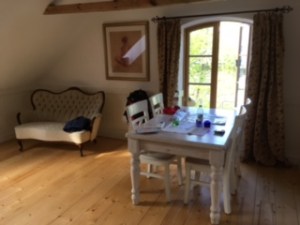
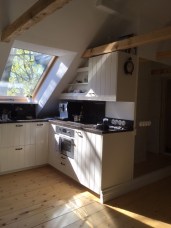
After my host left to return to her family in a modern suburb, I briefly unpacked my goods and rested my feet. Late afternoon shadows had creeped over the house as I wandered back onto the city streets. Not feeling ambitious, I crossed the main boulevard to a Reval Cafe on a far corner of Parnu Mnt. I lingered there over deli-style salad and sandwich, savoring the ineffable reality of being in my ancestor’s home town. I walked the neighboring streets of “modern” Tallinn, but had no interest in exploring the hectic lanes of Old Town that evening.
The next morning, Sunday 21 May, I followed email instructions to the location of a Quaker worship group. Through the website of an international Quaker organization, months before traveling, I found the names of Quakers in some of the towns I would be visiting. Roland Anton Rand is the leader of Tallinn’s growing Quaker Worship Group, and he had invited me to join them this Sunday. They do not gather for worship every Sunday, but he called a few attenders in expectation of my visit. A few blocks’ walk in the chilly and bright morning brought me easily – compared to Saturday’s hike through Tallinn – to the building on Kaarli Puiestee (Charles Avenue) where the Group leased a meeting room. I noted the room was in offices of an LGBTQ organization. A young man – 20’s-30’s? – approached with his bicycle about the same time I found the address. Then a young lady, and finally a 40-ish slender man in glasses. The latter was Roland, who would gracefully shape my experience in Estonia.
The avenue is bordered by a large green space and watched over by an immense church – Kaarli Kirik or St. Charles (Lutheran) Church – built in the 19th century to replace a much older wooden sanctuary that was commissioned by Swedish King Charles XI in the seventeenth century. Friend Roland had spent some of his earlier faith energies focused on that space.
Our little worship group settled into the austere office space and introduced ourselves and our reasons for being there. We then celebrated silent worship for about 45 minutes, with two people speaking in ministry, one in Estonian and one in English. After some further social conversation, we dispersed, but Roland offered to accompany for most of the afternoon.
Before lunch at one of his favorites, Cafe Josephine in the Old Town, we visited a sparse memorial on a hilltop to the north of Old Town, overlooking the harbor. The spot commemorates the sinking of the ferry MS Estonia in 1994, while en route overnight from Tallinn to Stockholm, with the loss of 852 lives. Most were Swedish or Estonian. Though little-known in the USA, the ship disaster remains the worst in peacetime after that of the Titanic.
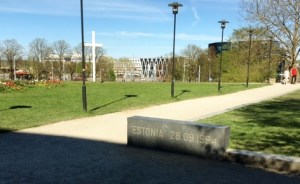
Near the memorial, on the same hilltop, Roland and I approached a heavy, moss-covered concrete bunker, a remnant of WWII Nazi occupation. It has been converted into a underground cafe, bar, and art gallery. The young lady from the Quaker worship group was exhibiting some of her paintings there. They all seemed to represent her musings on sexuality; she had only recently outed her lesbian identity. She is representative of an Estonian generation struggling to establish new identities in the fragile post-Soviet independence era. They face an older generation that is still fearful of breaking out of the gray and rigid conformity of the authoritarian past.
As we wandered back through the streets of Old Town, Roland pointed out various buildings of note, including the school where his younger son, Raimond, studies and sings in the choir. It is the Gustav Adolf Grammar School established by Swedish king Gustavus Adolphus as the Reval Gymnasium in 1631. He pointed out a building where he used to live, until he was evicted by the town council in the confusion of “privatization” after independence in the 1990’s. While lunching at Cafe Josephine (Roland knows the owner, just as he seems to know just about every other person of note in Tallinn), Roland related a bit about his personal history. When in his teens, and while still under Soviet rule, Roland became known as a talented musician (piano and organ). The Soviet authorities recruited him for a band of musicians that traveled to various countries to further the Soviet’s propaganda objectives. This included the African nation of Mauritius; in 1987, at the age of 21, Roland slipped off from the group’s handlers and successfully sought asylum in the U.S. Embassy. The Soviets threatened him and his Estonian relatives, but Roland arrived in New York City in November 1987. Fearing reprisals, he remained there, establishing a business in recording and producing, for several years. Contact with his future wife, Merle, finally drew him back in the mid-90’s. Today he is an established producer of documentary films and television ads, and continues to assist with major concerts and peace celebrations.
On Monday, 22 May, I took a mid-morning bus across the countryside to Haapsalu. I did not know exactly why I was going there or what I would see, but I followed the inner guide leading me that way. I was not disappointed. After staring at dairy farms and compact country houses from the bus for two hours, we arrived at the little bus depot – and old RR station – on the edge of Haapsalu. At the suggestion of a lady near the depot, I followed a well-defined walkway that arced along a marshy bay on the verge of the Baltic.
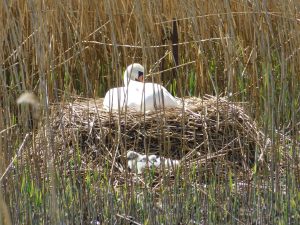
Practically alone, I lingered on the walk to absorb the peaceful view of wild swans nesting in the marsh and bobbing on the sea. If I had any lingering doubts about my purpose for traveling to this small town, they dissipated with the breezes. I followed the walkway for about a mile and then joined the quiet lanes of the town. I passed several attractive inns and spas, in uniform old wooden houses, on my way to the old town center, dominated by the ancient cathedral and castle established by the Catholic Church in 1279. They called themselves the Bishopric of Osel-Wiek, under the joint authority of the Pope (through his archbishop in Riga) and the Holy Roman Empire. Riga and the surrounding Latvian populace had been “Christianized” in the preceding 100 years through crusades impelled by Rome.
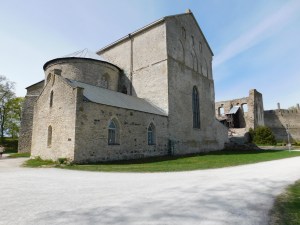
As I wandered the castle and the sanctuary, a working museum, I awakened to a deeper understanding of the traditional partnership of church and state in medieval Europe. The Bishopric was an ecclesiastical state, with the priests or canons overseeing religious, political, and social norms and practices. In the remaining structures, it is difficult to distinguish the military castle from the spiritual sanctuary. Both are museums today.
A plaque on the wall of the castle museum translates the original Charter that established this religious state in 1279; the recitation of the rights of the canons and of the residents echoes that infamous “Doctrine of Discovery” that would permeate European colonialism of subsequent centuries: all rights of usage adhere to those who are confessed Christians, while property would be simply taken from heathens.
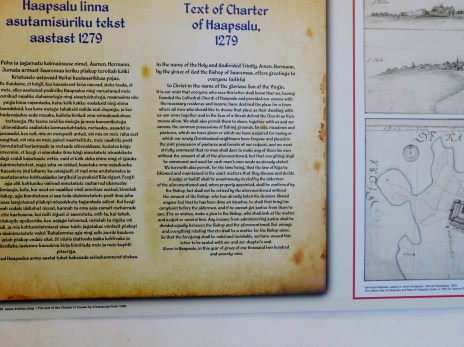
I had travelled over four thousand miles from home, and stared at the same ideology that drove the conquerers and colonialists to America, providing a sanctified framework for oppression and slaughter of the native “aborigines.” We lamented that history in my home Quaker Meeting; why should I be surprised to find the same framework at the far end of Northern Europe?
 Following the Spirit