
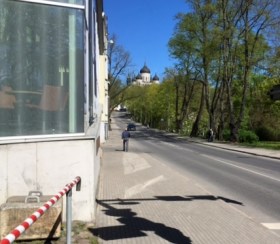
The day after enjoying the journey outside of Tallinn, to Haapsalu, on Tuesday 23 May I chose to concentrate on a visit to the Occupations Museum, a modern glass and concrete building a few blocks from my loft in P. Suda. Bypassing so many reconstructed monuments to the feudal past, I was drawn to this demonstration of the present-day view of Estonian history. Crossing Kaarli Avenue in the shadow of St. Charles’ Church, I approached the contemporary wall of glass on the corner of Toompea Street. I looked up the hill, also named Toompea, and saw the onion-domed Nevsky Cathedral pressing against the blue Baltic sky. It seemed that the Museum was sticking its thumb in the monument to the oppressive past; or is that the Cathedral’s thumb – or finger – gestured at the clear-eyed exposure of the history of occupations? Not too distant from both, the square steeple of St. Nicholas’ Church dominates Old Town; build by Gotland Germans in the thirteenth century, St. Nicholas’ was reconstructed after Soviet bombing during WWII.
The museum’s name refers in the plural to occupations, as its exhibits cover the period of 1939 – 1991, from the Molotov-Ribbentrop Pact until the restoration of Estonian independence in August 1991. Although the Soviets annexed Estonia – and other Baltic states as well as portions of Poland, Finland, and Romania – soon after the Pact, the Nazi armies violated the Pact by occupying Estonia in 1941, after having invaded Poland. Nazi occupation – with all the forced labor and ethnic cleansing that entailed – ended with the Soviets marching back into Estonia in 1944. Although the Soviets, under Lenin, had originally granted the Republic of Estonia its independence in 1918, upon its re-occupation in 1939, Moscow chose to re-establish a Socialist Republic (read: colony) until 1991.
The Museum’s exhibits are stark and factual, accompanied by a series of documentary films on monitors above each themed station. The exhibits emphasize harsh living conditions for Estonians, including slave labor, deportation to Nazi or Soviet camps, and evident genocide of tens of thousands of those deported. One of the most striking images at the Museum entrance are a host of suitcases made of concrete, with metal handles, that speak of the forced deportation – and disappearance – of Estonian residents. The mood, lighting and stark artifacts are reminiscent of the Holocaust Museums around the world that receive more attention. On the main floor, one can listen to oral histories of survivors while gazing at simple artifacts and occupier uniforms that demonstrate the dismal life under occupation. On a lower level, within bare concrete walls, the Museum hosts an exhibition of photos about migrants from Africa and the Middle East to Europe. Now a member of the European Union, Estonia is being pressured by its wealthier neighbors to accept more of these recent refugees.
Dazed after a couple hours of that fare, I wandered into the sunlight and through Old Town. I toured the old craftsmen alleys, where the medieval guild artisans labored over a wide variety of products, including weaving, ceramics, leather goods and woodwork. I had a vague hope of sensing the distant presence of my great-great-grandfather, a cabinet-maker who carried his craft to the New World. It is tough to visualize the nineteenth-century past that is obscured by the omnipresent emphasis on tourism. The streets are filled with inns and restaurants, interspersed with old religious and municipal buildings. So much of the town has been rebuilt, it feels like a Disney facsimile park entitled “Ancient Medieval Town,” with round towers and square steeples and humble monasteries, oh my.
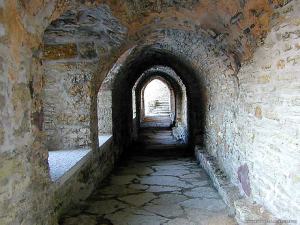
And yet, and yet: an image rose in my mind, of a young man in simple clothes and a small bag, nervously leaving his home and work, and boarding a wooden sailing craft in the evening, heading out on the Baltic and into the unknown. At great risk, he left friends and family; why did he leave, and what did he expect to find? It was a ghostly feeling, but one I trusted. I see him walking through the narrow cobbled streets, footsteps echoing on the dim heavy walls, briefly glancing behind. There in the bright mid-day light, I shivered with him.
Then it was Wednesday, midway through my Estonian journey, and I was expecting the arrival by afternoon ferry of my niece who has been studying early childhood education in the Netherlands. Friend and voluntary guide Roland planned to join me in greeting her, then with his wife join Jenn and I for supper in Old Town. But first, after dropping off a bag of laundry at a service near my house, I chose to board the infamous Red tourist bus that plies its way around town and its outskirts. This was a bit of surrender, following the classic tourist behavior, but I was rewarded by an informative overview of the town and outlying areas. In fact, the bus does not enter Old Town, but provides a well-narrated sense of the breadth and dynamism of the entire city, including the expanding zones of factories, high-rise apartments, and gleaming offices. But it also reveals the growing pains: blocks of both drab soviet-era residences mixed with older grand homes that have descended into shabby disrepair while locked in litigation limbo over privatization. From the rambling double-decker bus I glimpsed the edge of a district called Kadriorg, where the Russian Emperor Peter celebrated his conquest by laying out a vast park and palace in honor of his wife Katerina.
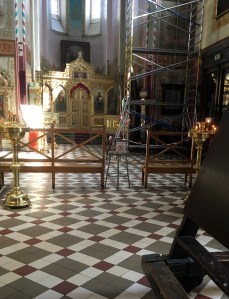
Hobbled by a couple of toe blisters produced by too-new and stiff hiking boots, combined with miles of daily walking, I hopped off the Red Bus in the port area in search of some softer slip-on shoes. Once-acquired, I rode the bus to the Toompea area, the hill that is crowned by the Russian Nevsky cathedral and by the Dome Church of St. Mary, and surrounded by a large green area. A glimpse of the Nevsky towers is seen in the photo heading this blog. I mounted the steep stone steps, past a babushka-style lady begging for alms, into the darkened, gold-clad interior. A large section in the rear is devoted to the sales of mass-produced religious icons. Interior photos are prohibited; I surreptitiously snapped a couple on one side of the chapel, where scaffolding and workmen revealed the ongoing maintenance of this century-old symbol of past Russian dominance and of the weight of the Church behind the fist of imperial power. The gold cladding on the altars was enabled by the marching of soldiers’ boots.
I walked to the offices of Tallinn’s premier private language school, and interviewed its director. I had mentioned in passing to Roland my random thought of teaching English in Estonia, and he set up this meeting. A kind, meticulous, and well-spoken lady, the director invited me to give a brief teaching demonstration the next day, something required of all the institute’s teachers. I was tempted, but declined; my work is nearer home, where I teach English to Latino immigrants. I then met Roland and rode the tram to Terminal D to meet niece Jenn. We had not seen each other in a few years, though I kept up with her teaching career through my sister.
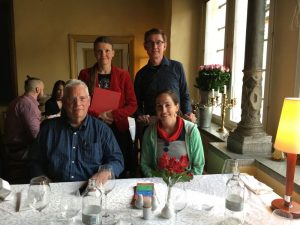
After settling her in an apartment next to mine at P. Suda – its availability an accident or work of the spirit? – we met Roland and his wife Merle at the sumptuous Restoran Balthasar in Old Town. This was perhaps the most elaborate meal I had on my entire ScanEst journey, and we enjoyed exchanging views on education and child development. Merle, in addition to mothering three fine children, is a published writer, a part-time teacher, and a caretaker for a ninety-five year old defector from the Nazi army. She gave me a copy of her beautiful book entitled “Kingitused,” or Gifts. Many of the photo illustrations were provided by her older son, Rafael. I believe she and Roland are dedicated to offering gifts to friends and strangers.
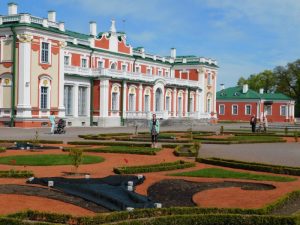
On Thursday, 25 May, Jenn and I directed out attention to the immense Czar palace and the art museum complex in the parks of Kadriorg. We spent most of our time at the Kumu Art Museum, the largest and most impressive of Estonia’s many art museums. It houses the best representation of Estonian art from the 18th century to the 1990’s, and the works provide a visual history of changes in artistic sensibility over those centuries, from realistic representation of the traditional countryside to impressionistic and modernist works influenced by the major schools in Western Europe. My niece was able to spend more hours there than I, as my raw, blistered toes drove me to retreat to the apartment for a couple of hours.
Meeting her at Vabaduse Valjak – Freedom Square – in late afternoon, we wandered Old Town in search of a restaurant, wanting to avoid the most blatantly touristic. We at last settled on an unusual place on the border of Old Town and the modern dynamic city, called Manna La Roosa. The interior decoration, the eclectic clientele and menu all give this place a Bohemian feel. We felt quite content with our choice as we strolled home to P. Suda in the mid-evening twilight.
Two locations highlighted our last full day, Friday, in Tallinn. First, I accompanied Roland and Jenn to her appointment to speak with teachers at a private pre-school. Jenn quickly settled into an extensive sharing of views on early-childhood development in one of the classrooms, one teacher providing the necessary translations. Meanwhile, as the irritation in my molar and gum had worsened, dear Roland took me to the top clinic in Tallinn, and talked his way into a nonexistent appointment space with one of the most talented dentists in the country. As we were waiting outside the dentist’s office, Roland commented: “We’re really lucky; it’s Friday and she is headed off to vacation after this.” I looked at him, smiled, and said: “Luck? I don’t think so, Roland. Trust the Spirit.” He gave me a bemused look.
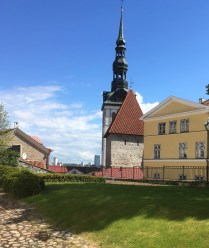
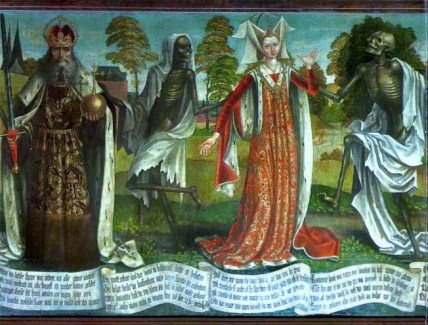
Then, reunited with Jenn and my gum infection tamed, Roland talks his way into the museum and concert hall within St. Nicholas’ Church, although the museum is officially closed in preparation for a concert that evening. Roland knows the concert-master, who he greets, then takes us to the lower level to view what is perhaps the most precious medieval painting in Europe: the sole remaining remnant of Bernt Notke’s Danse Macabre. Completed in the fifteenth century, only a fragment of the original 30-meter work is preserved; an earlier version of Notke’s work, accomplished in Lubeck, Germany, was destroyed. This striking tapestry depicts dark skeletal images of death dancing with lords and ladies. Several other intricate medieval altar-pieces are on display at St. Nicholas’. Contemplating these dark medieval views of mortality and salvation felt like a fitting manner to wind down my once-in-a-lifetime visit to this ancestral land.
 Following the Spirit