
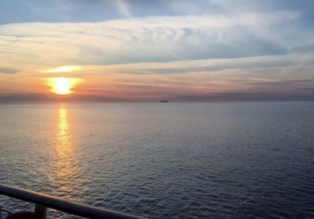
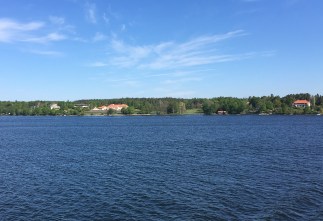
Saturday 27 May began and ended with farewells; first, at 4 AM, a hurried goodby to niece Jenn as she headed for the Tallinn and Riga airports to land in Amsterdam later that morning; then, restful tea and cake with Roland, Merle, and family in their apartment before boarding the overnight ferry to Stockholm. Finally, I am on the water, slowly easing out of Tallinn harbor, watching the Old Town towers shrink in the evening light. After a lush feast of seafood and walks on the deck to admire the long Baltic sunset, I retired to my private berth. Unfortunately, a nearby gang of Swedes kept up a drunken revelry most of the night, and my bunk bed was narrow and hard. But, after a brief sleep, I enjoyed the slow entry into Stockholm’s harbor in the clear Sunday morning air, winding through the archipelago of lush islands with sumptuous homes along the shore.
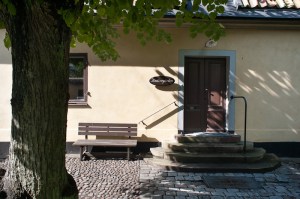
I had communicated by email with a member of the Stockholm Friends’ Meeting, and was invited to attend their usual 11AM Meeting for Worship. Disembarking at the ferry terminal about 10AM, I made a snap decision to take the first and only taxi ride on this entire three-week journey. This meant a dash on highways and city streets from the north of Stockholm, over some bridges, to an upscale island suburb just south of the town center; the taxi driver wondered, “Do you know this is in the expensive area of Sodermalm?” But after repeated checking of his cellphone GPS and a bit of wandering in narrow streets, he pulled up to an 18th-century mansion. I was greeted warmly in the foyer and, after gratefully removing my heavy boots and depositing my luggage, was ushered into the large worship room. Perhaps 12-15 worshipers were seated in straight-backed chairs, facing each other. I settled into the familiar reverent silence, broken in the next hour only by a couple of spoken ministries. Following the worship, I joined six or so Friends in a garden courtyard over a simple soup offered for donations to a homeless service. We enjoyed relaxed, wide-ranging discussions of immigration, Swedish politics, motivations for social activism. My Swedish Friends were agreed that a recent election had pushed back pressure from the extreme right. On the other hand, admitted a slender, poised lady to my left, “the myth of our welfare state cannot hide the poverty and homelessness that exists on these streets.” A well-spoken older lady from Uppsala, an old university town about an hour’s commute north of Stockholm, was familiar with some of my favorite American Quaker writers and maintains the Stockholm Friends’ large library.
As with most of my Quaker acquaintances in the USA, this gathering appears composed of well-educated, professional whites. We make a business of “helping” the less fortunate.
A Friend, walking his bicycle, led me to the Tunel-bana station to catch a subway that would connect me to the correct “T” to Enskede, a southern suburb that held my next hotel. After descending the Svedmyra station, I and my sore feet were delighted to see that my hotel – Maude’s – was a short walk on a leafy quiet street. After a busy week of wandering in Estonia, and a noisy overnight ferry ride, I felt blessed to land in a peaceful haven. But after checking in, my first order of business was to search for sandals to replace my boots. Fortunately, a couple stops back on the same T brought me to a shopping mall and a shoe store. With great relief I found some comfortable strap-on sandals, just before the store closed at 5PM. Liberated from most pain, I ventured two T-stops north, to Skanstull, and found a lively Sunday-evening crowd on a boulevard full of cafes. I settled into a pizza-kebab place to watch suburban youth parading by, celebrating the unusually warm temperatures.
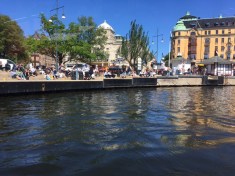
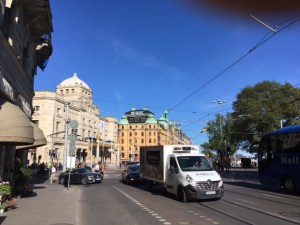 Monday, May 29, my last full day in Stockholm, began with a leisurely breakfast at Maude’s Hotel. Riding the now-familiar train into central Stockholm, I decided to first review the city landscape from tour bus and boat. The tour boat circles many of the fourteen islands that comprise the city, including Gamla Stan, the old royal palace center that I had toured on my first visit a couple weeks before. After exploring the smaller islands of Skeppsholmen and Kastellholmen, formerly dominated by a naval defense base but now turned over to museums, I chose to focus on the dramatic-looking Nordic Museum (Nordiska Museet). This is the Gothic-style building that fascinated me before, next to the Vasa Museum that I had spurned, much to the dismay of my hip-challenged AirBnb host.
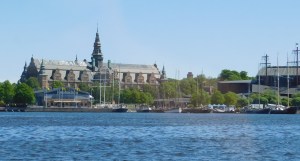
The Nordic Museum displays what anthropologists call the “material culture” of Sweden, past and contemporary. The featured exhibit during my visit was about the impact of light – or the lack thereof – on Nordic peoples, due to their existence at 60 degrees latitude north or above. They endure the long winters with no more than six hours of sunlight in the brief days, and up to eighteen hours of daylight during June through August. This cycle helps explain the manic exuberance I have seen as the long winter gave way to more light and the end of May. The collection of traditional light sources – wood fires, candles, paraffin lamps – emphasizes that Swedes and Finns and Norwegians would ration these sources in the winter, so that people operated in murky dimness in their homes. Did that lead to some darkness of human spirits? Is that why thriller novels like those of Henning Mankel are so dark?
I was also thrilled to review the Museum’s extensive materials on the Sami, or indigenous people of extreme northern Scandinavia and Russia, previously called Laplanders. The message of the exhibit is twofold: 1) to represent the richness and ingenuity of their artifacts and clothing, fashioned by hand to survive the rugged world of hunting, gathering, fishing, and reindeer farming in the Arctic zone, and 2) to recount the awakening of Scandinavian people to their traditional prejudice against the Sami, who are similar to the Inuit of the American and Asian continents. Swedes especially repent the past existence of an academic institute, in Uppsala, dedicated to the study of the Sami as if they were of a different, inferior species. My thoughts quickly ranged to the Anglo-European treatment of Native Americans, past and present. The Nordic Museum has a small, separate exhibit on baptismal blankets and robes going back to medieval churches; the commentary notes that the infants were considered “heathen,” or not quite human, until they were “saved” by the dousing ritual. There is an unintended, implicit connection of the two exhibits: were the heathen Sami also considered less than human?
Emerging from this ethnographic museum in the bright late afternoon, I walked back through the business district of Stockholm as office workers raced to the tram stops or settled into outdoor cafes to mingle sunlight and wine. Before riding south to my own retreat, I once more glimpsed the gleaming white tower of the Royal National Theater, where such great actors as Ingrid Bergman and Max von Sydow developed their art. After a quiet evening in the suburban hotel, I returned to the train station to board the fast train back to Copenhagen. On a cloudy and rainy day, the train seemed to hurtle much more rapidly southwest than I recalled its motion a couple weeks prior.
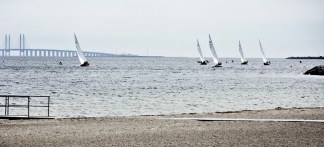
This time, I got off the train at the CPH airport – near the western end of the long Oresund Bridge from Malmo, Sweden – to take a brief metro ride to the area of Amager Strand, a southern suburb of Copenhagen, to find my last hotel stop before the flight home. The hotel felt industrial, cold, and confined, so I was driven quickly back out to walk near the beach and enjoy a neighborhood restaurant, the Cafe Phenix – Amager. Enjoying the sharp sea breeze, I alternately stared at the long line of towering wind generators and the great bridge that carried my train to and from Sweden. In my brief last stay in this bedroom community of Copenhagen, I returned again and again to the Strand.
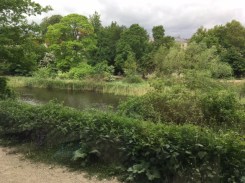 On my last full day of this ScanEst trip, I chose to focus on the great SMK, Statens Museum for Kunst or National Gallery of Art, on the edge of the Botanic and Kings Gardens. Following a crowded ride on the metro from the Oresund Station to the Norreport Station, I hiked again through the vast grounds. I had walked these grounds over two weeks before, found the SMK closed, and vowed to return when it was open. On a gray and misty Wednesday, 31 May, I strolled again past the Rosenborg Castle that dominates the Kings Garden (and pictured in an earlier post), and sat on a bench to watch the many birds in the marshes and ponds of the Botanic Gardens, before approaching the high wide stone steps of the SMK.
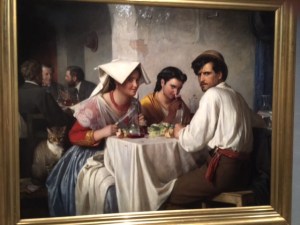
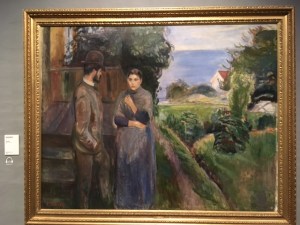
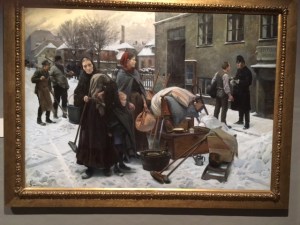
Although weary from days of walking through northern Europe, the rich and immense collections at the SMK kept me moving from room to room for hours. The premier exhibit was entitled “Nordic Highlights,” an echo of the exhibit on light at Sweden’s Nordic Museum, covering works of Danish and other Scandinavian masters from 1750 to 19o0. The chronological arrangement of these works demonstrated the changes in style and culture, evolving from focus on elegant portraits of aristocrats to representation of harsh country life. There is also a selection of European Art from 1300 to 1800, and a surprising display of French “modern” art of 1900 to 1930, including works of Matisse, Braque, Modigiani. My favorites, though, are examples of Nordic social realism in the mid-to-late nineteenth-century works of Munch, Block, Ancher, and Henningsen. I was delighted to learn that photographs were allowed, without use of flash.

I
After riding the rails back to my odd industrial hotel, I spent a quiet final evening in Copenhagen, washing and organizing clothes, then walking again on the Amager Strand and dining at my favorite Cafe Phenix. My journal says: “Tired and I wanna go home. Rest my feet. Feed my cat.”
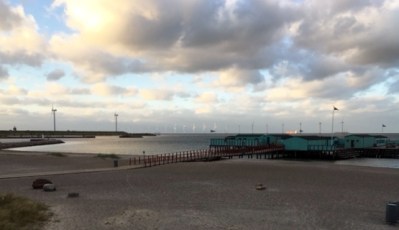
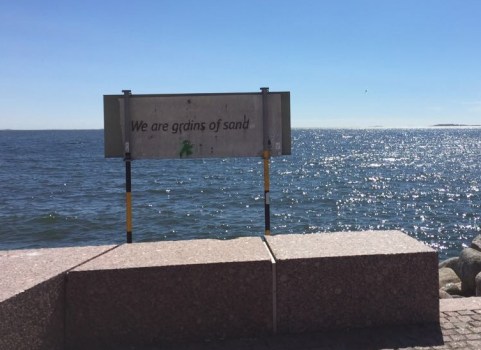
Thursday June 1st extended by six hours for me, as I flew west with the sun for eight hours to Dulles, then grabbed one more gift from the Travel Spirit as I was able to catch an evening flight back to Greenville airport, find my car and blearily drive home at about 3 AM on my body clock. It has taken me nearly a month to recollect the journey and set it down here. I am reminded of one more image from Haapsalu, Estonia, looking out at the Baltic.
 Following the Spirit