
Dear Friends,
My name is Roland Rand. I am the clerk of the Tallinn Meeting Group in Estonia. Quaker Friends visiting Tallinn from the USA have suggested that I write about my journey of faith. So I will introduce you to my experiences that led me to practice and promote Quaker faith and testimonies.
When I was born in Estonia, in 1966, the country had been occupied by the Soviet Union since defeating Nazi Germany. I entered a life of music at age five, playing the piano, and continued musical studies in piano, composition, and conducting at the Higher Music School in Tallinn. I was raised by my mother and a spiritual grandmother who attended church on Sundays, often taking me along. The Soviet state was atheistic and people attending church were suspect. On several occasions, Soviet agents followed us on the way to church. As a consequence, on one occasion my mother was reprimanded at work and her children were denied permission to go to summer camp.
When I continued to worship, I was apprehended by the occupying authorities and sent to work in a rubber factory a total of 100 hours during weekends. Some religious families were punished more severely, by taking away their children and placing them in children’s homes, with the aim of making Soviet citizens of the children.
In 1985, at the time of Gorbachev’s glasnost, I joined a freedom movement while I was still in high school. Despite discrimination against people who practiced religion, I continued to attend church and conduct a choir. Freedom was expressed by prayer meetings held in the church office. Risking capture by the KGB, I also helped Lutheran pastor Jaan Kiivit to smuggle bibles from Finland, by hiding them in sacks of flour.
Although Moscow recruited young men from the Baltic States to clean up the site of the nuclear accident in Chernobyl, I managed not to have to serve in the Red Army by working as an organist with the Tallinn Philharmonic band Nemo. The state agency Gosconcert organized our band’s concert tours in the Soviet Union and abroad. Whenever we toured in the West, our passports and money were taken from us so that we could not escape. We were not paid in cash, only housed and fed in Spartan conditions. In 1987, our band was sent to the island of Mauritius to mark the October Revolution, although the Soviet music repertoire evinced little local enthusiasm.
By touring with the band outside the Soviet Union, I gradually realized how bad our home conditions were. After agonizing inner debate, I decided in Mauritius that I would defect to the West. We had been warned not to have any contact with local people and even to go walking in town required a special permit, seldom by the director and never to young people like me.

With the help of a local person, I managed to sneak out to the US embassy and ask for political asylum. U.S. Ambassador Ronald Palmer personally assisted me, and the whole embassy staff was very helpful. When the Soviet embassy discovered where I was, it asked to meet with me, allegedly to determine whether I had done this of my own free will or had I been “forced” by the US authorities. The meeting took place in a Mauritius government building, as a neutral site, with guards provided by the US embassy and the government of Mauritius. Ambassador Palmer came with me and several officials and an interpreter came on the Soviet side.
The Soviet representatives asked several questions, but basically wanted to know whether I had gone freely or was forced to go to the US Embassy. I answered consistently that I had come by myself, and requested asylum myself. They warned me that my defection would cause serious problems for my mother and brother living in Tallinn and that I would lose my USSR citizenship. I was likewise warned that I would have serious difficulties ahead, such as being run down by a car or left destitute on the street. Despite all that, I did not change my mind, and arrived in the United States on November 12, 1987. I have good memories of the kindness shown by the people at the American embassy.
The US Catholic Conference of Migration and Refugee Services provided housing and clothes, and I initially worked in the Conference office as an assistant. I soon met other Estonians in New York, and found a job as a janitor at the Estonia House. There I met an Estonian family that “adopted” me to live in their home in Westchester County. A member of the family was a nurse at a local hospital and found me a job there as an orderly. I faithfully studied English at a local school where I occasionally gave music performances. I was honored to attend the world Estonian music festival, ESTO, in Melbourne, Australia in 1988, and was invited to perform there with a band led by Urmas Karner.
After returning from Australia, I began working as an assistant organist at the Estonian Lutheran Church in New York City while also studying music production. That led me to found a music production company, while working at night as a doorman for subsistence. In my free time I participated in Estonia’s freedom movement by attending public meetings in Central Park, and near the United Nations building, during Captive Nations Week in 1990. Estonia regained its independence in 1991 as the Soviet Union was collapsing. I had brief contact with Quakers in New York during that time, but did not consider myself ready to join them.
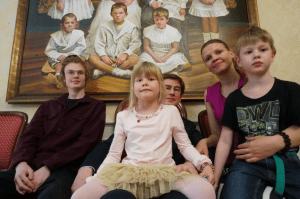
The Estonian Film Institute invited me to Estonia in 1997 to help with the modernization of its film studio. That year, I met my wife Merle who was a literature student at Tallinn University. I began to feel safe there, as the last units of the Red Army pulled out of Estonia on August 31, 1994. After considering a return to work in New York, I chose to remain in Tallinn and, in 1998, to marry Merle. While working at various studios as a sound engineer, I taught Sunday-School at a church where I served as an assistant choral conductor. We were very happy to live in independent Estonia and raise a family. Now we have three wonderful children: Rafael is 18 years old, Raimond is 10, and Laura is eight.
I developed a deeper interest in theology and as a result, I studied at the Institute of Theology (Estonian Evangelical Lutheran) during 2008 to 2011, and was offered minister positions. However, I did not feel comfortable with the church institutions. Due to my growing interest in ecumenical outreach, in 2009 I founded an NGO called Diverse Faiths Alliance. Although Estonian churches have not historically been open to the ecumenical spirit, I believe that in a fast developing multicultural society, peaceful coexistence of different religions becomes increasingly important. The DFA promotes peaceful resolution of the continued Estonian anger against Russians.
Through my work on the Diverse Faiths Alliance, in 2010 I met Myra and Steve Ford, practicing Quakers from England. They both taught English in a private language school and at the Tallinn prison. She persuaded me to screen an inspirational film about civic courage in a Palestinian West Bank village, with a personal introduction by Mr. Nabil Al-Wazir, the Palestine Liberation Organization’s representative in Finland and the Baltic States.
Merle and I joined the Quaker worship organized by Myra and Steve; Myra served as the clerk of the Tallinn Worship Group. After she and Steve moved to the UK in 2012, Bob Gilchrist, a diplomat at the US Embassy, became clerk, offering his apartment as the Meeting’s venue. I assumed the role of Meeting clerk after Bob was transferred from Estonia in 2014.
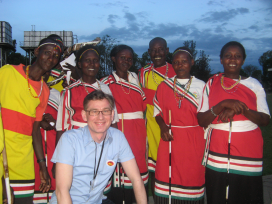
During the years of its existence the Tallinn group has been very active in peace and social justice movements. Currently we have 12 regular attenders for our monthly worship meetings. We seek and welcome visitors, discuss Quakerism and meditate together. Based on our worship group’s connection with the Europe/Middle East section (EMES) of Friends World Committee for Consultation, I was fortunate to attend a World Gathering of Friends in Kenya in April 2012.
The Estonian Quakers most ambitious undertaking, to date, has been the 2014 peace initiative in Kiev and Odessa, Ukraine within the framework of “A Peace Dialogue in Eastern Europe.” I organized this effort with funding from EMES, spurred by the suffering caused by Russian military incursions. There we led Alternatives to Violence training and a roundtable about cultural diversity with the aim of advancing peace in the region and creating a better understanding about the countries in Eastern Europe.
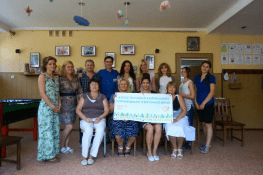
Starting in 2010, the Tallinn Worship Group has organized annual events marking the Day of Peace, with activities such as “One Minute of Peace”, collaborating with the Estonian Women’ Studies and Resource Centre (ENUT). More recently, the Day’s events have consisted of outreach to refugees at the government-sponsored Vao Refugee Center. The latter is a small shelter for immigrants from Muslim countries and from Ukraine, with a population varying between 80 and 100. The refugees generally stay for about 6 months while arranging permits to work in larger European countries.
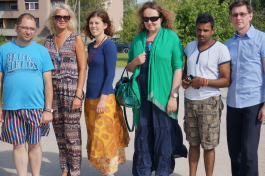
The Tallinn Worship Group has limited resources but some ambitious goals, including:
- Registration as an NGO in accordance with government regulations;
- Translation of core Quaker writings into Estonian, with subsequent publication and distribution;
- Interfaith leadership of Alternatives to Violence training in Estonian prisons;
- Establishment of a permanent Estonian Quaker Center.
Based on some recent contributions, international and local, we have begun translating some modern treatises explaining Quaker faith and practice. We have been blessed by the recent interest and assistance from European and American Quaker organizations and individuals who have taken an interest in our interfaith peace work. If you would like to know more about our Group, please contact me or my American friend Adolph Hoehling.
In the Light,
Roland Anton Rand, roland.rand@mail.ee
U.S. Contact: Adolph (Dolph) Hoehling, dhoehg@gmail.com
 Following the Spirit