
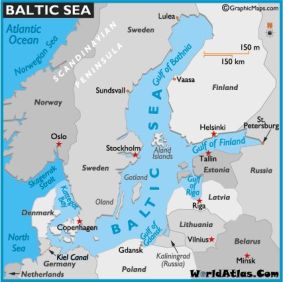
On May 20, 2017, I landed by ferry in Tallinn, Estonia, following one night in Copenhagen, and two nights each in Stockholm and Helsinki. Each stop was a high-speed snapshot colored by rented room or apartment, as well as by the random encounters with kind, helpful Europeans.
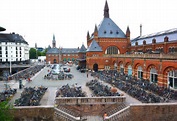
Five days earlier, Monday May 15, I landed in Copenhagen at 7AM (1AM on my body clock), following little sleep for two nights. The transfer by train to Central Station and the five-block hike to the AirBnb apartment was without incident, except for the bleary wandering of a stranger to find the street named Victoriagade where my apartment building stood. My asking for directions was hampered by my inability to pronounce the street name. I was put off by the rough trade wandering the rundown neighborhood (what did I expect, so near the RR station?), but was pleased to finally encounter my host/owner’s assistant at the locked entrance.
I was early; I hoped only to leave my roller bag while wandering the city until check-in time. I quickly learned that roller bags are tough to wrangle on those rough cobble-stoned streets that tourists consider quaint, and tough to lug up the steep staircases of old apartment buildings. My burly Danish hostess was initially annoyed to see me so early, but grew more hospitable after I returned from a couple of hours of languishing in a nearby cafe. Ah the cafes, where the price of an espresso and perhaps a toasted ciabatta secures a table by the window and free wireless without time limit.
First impressions of Kobenhavn: the residents are open, helpful, and meticulous, pausing generously to give the wandering foreigner directions – in impeccable English. You are more likely to run into a traffic jam of fast-moving bicycles than one of noisy automobiles. The urban landscape of this city, and much of Scandinavia, seems dominated by massive but colorful stone buildings, generally four or five stories high (I recall this feature in Amsterdam as well). The structures seem to more defend against the outside than to open interiors to the clear pale northern light; though, once inside, I realize the windows – and frequent skylights – are strategically-placed to capture that precious sunlight. The heavy stone walls – capped by steep, often mansard, roofs – guard the inhabitants from the enduring chill of long winters and the monotony of a few long summer days. I develop an hypothesis about the Danish culture: the people have survived as a tiny vulnerable country by trading fairly, peacefully and openly with most other nations, maintaining Copenhagen as an open entrepot.

At the end of a full day of wandering the central city, including the Kings Garden – Denmark is a Kingdom as well as a welfare state – I stumbled in jet lag stupor to a plaza filled with open-air markets and cafes, and gratefully settled on a bench with a seafood salad. An American settled next to me, and shared that he was on a bicycle tour and had been biking in the Danish countryside all day. He asked me what he should see in Copenhagen the next day; naturally I provided him my expert recommendations following a few hours’ of walking. I encouraged him to walk in the royal gardens, with the Rosenborg Castle as a centerpiece. The castle was built under the direction of King Christian IV, in the 17th century. I did not recommend the famed Tivoli Gardens; they resembled a run-down amusement park.
After the uneventful one-night stopover at that Victoriagade lodging, I traveled on to Sweden (by rail), then Finland (by air), then Estonia (by ferry), lugging that roller bag and heavy backpack around to four different households in five days; not the ideal way to explore new lands. I justified it then, and now, by two stories I tell myself: that my main goal was to experience Estonia, and that I was coming back through Stockholm and Copenhagen for two nights each after Estonia. We shall see how that played out.
One of my favorite photos from that first day in Denmark, with the Town Hall tower reaching for the evening sky: 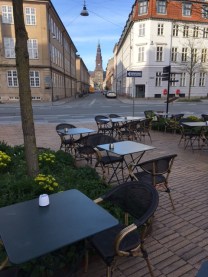


 Following the Spirit