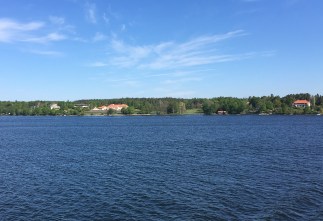
Baltic Sunset, Atlantic Sunrise

Tallinn to Stockholm Ferry
Lidingo, Stockholm archipelago


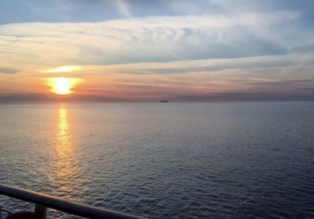
Saturday 27 May began and ended with farewells; first, at 4 AM, a hurried goodby to niece Jenn as she headed for the Tallinn and Riga airports to land in Amsterdam later that morning; then, restful tea and cake with Roland, Merle, and family in their apartment before boarding the overnight ferry to Stockholm.  Finally, I am on the water, slowly easing out of Tallinn harbor, watching the Old Town towers shrink in the evening light.  After a lush feast of seafood and walks on the deck to admire the long Baltic sunset, I retired to my private berth.  Unfortunately, a nearby gang of Swedes kept up a drunken revelry most of the night, and my bunk bed was narrow and hard.  But, after a brief sleep, I enjoyed the slow entry into Stockholm’s harbor in the clear Sunday morning air,  winding through the archipelago of lush islands with sumptuous homes along the shore.
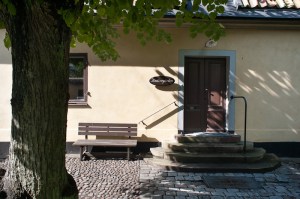
Stockholm Meetinghouse


I had communicated by email with a member of the Stockholm Friends’ Meeting, and was invited to attend their usual 11AM Meeting for Worship.  Disembarking at the ferry terminal about 10AM, I made a snap decision to take the first and only taxi ride on this entire three-week journey.  This meant a dash on highways and city streets from the north of Stockholm, over some bridges, to an upscale island suburb just south of the town center; the taxi driver wondered, “Do you know this is in the expensive area of Sodermalm?”  But after repeated checking of his cellphone GPS and a bit of wandering in narrow streets, he pulled up to an 18th-century mansion.  I was greeted warmly in the foyer and, after gratefully removing my heavy boots and depositing my luggage, was ushered into the large worship room.  Perhaps 12-15 worshipers were seated in straight-backed chairs, facing each other.  I settled into the familiar reverent silence, broken in the next hour only by a couple of spoken ministries.  Following the worship, I joined six or so Friends in a garden courtyard over a simple soup offered for donations to a homeless service.  We enjoyed relaxed, wide-ranging discussions of immigration, Swedish politics, motivations for social activism.  My Swedish Friends were agreed that a recent election had pushed back pressure from the extreme right.   On the other hand, admitted a slender, poised lady to my left, “the myth of our welfare state cannot hide the poverty and homelessness that exists on these streets.”  A well-spoken older lady from Uppsala, an old university town about an hour’s commute north of Stockholm, was familiar with some of my favorite American Quaker writers and maintains the Stockholm Friends’ large library.

As with most of my Quaker acquaintances in the USA, this gathering appears composed of well-educated, professional whites.  We make a business of “helping” the less fortunate.

A Friend, walking his bicycle, led me to the Tunel-bana station to catch a subway that would connect me to the correct “T” to Enskede, a southern suburb that held my next hotel.  After descending the Svedmyra station, I and my sore feet were delighted to see that my hotel – Maude’s – was a short walk on a leafy quiet street.  After a busy week of wandering in Estonia, and a noisy overnight ferry ride, I felt blessed to land in a peaceful haven.  But after checking in, my first order of business was to search for sandals to replace my boots.  Fortunately, a couple stops back on the same T brought me to a shopping mall and a shoe store.  With great relief I found some comfortable strap-on sandals, just before the store closed at 5PM.  Liberated from most pain, I ventured two T-stops north, to Skanstull, and found a lively Sunday-evening crowd on a boulevard full of cafes.  I settled into a pizza-kebab place to watch suburban youth parading by, celebrating the unusually warm temperatures.
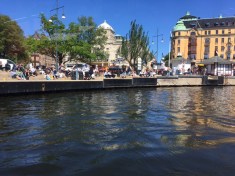
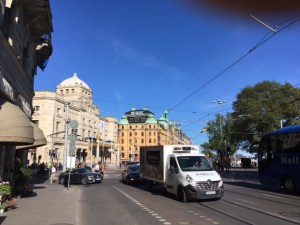
Royal Dramatic Theater

Monday, May 29, my last full day in Stockholm, began with a leisurely breakfast at Maude’s Hotel.  Riding the now-familiar train into central Stockholm, I decided to first review the city landscape from tour bus and boat.  The tour boat circles many of the fourteen islands that comprise the city, including Gamla Stan, the old royal palace center that I had toured on my first visit a couple weeks before.  After exploring the smaller islands of Skeppsholmen and Kastellholmen, formerly dominated by a naval defense base but now turned over to museums, I chose to focus on the dramatic-looking Nordic Museum (Nordiska Museet).  This is the Gothic-style building that fascinated me before, next to the Vasa Museum that I had spurned, much to the dismay of my hip-challenged AirBnb host.
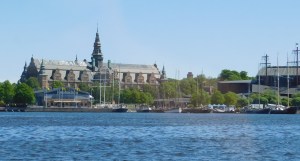
Nordic and Vasa Museums

The Nordic Museum displays what anthropologists call the “material culture” of Sweden, past and contemporary.  The featured exhibit during my visit was about the impact of light – or the lack thereof – on Nordic peoples, due to their existence at 60 degrees latitude north or above.  They endure the long winters with no more than six hours of sunlight in the brief days, and up to eighteen hours of daylight during June through August.  This cycle helps explain the manic exuberance I have seen as the long winter gave way to more light and the end of May.  The collection of traditional light sources – wood fires, candles, paraffin lamps – emphasizes that Swedes and Finns and Norwegians would ration these sources in the winter, so that people operated in murky dimness in their homes.  Did that lead to some darkness of human spirits?  Is that why thriller novels like those of Henning Mankel are so dark?

I was also thrilled to review the Museum’s extensive materials on the Sami, or indigenous people of extreme northern Scandinavia and Russia, previously called Laplanders.  The message of the exhibit is twofold:  1) to represent the richness and ingenuity of their artifacts and clothing, fashioned by hand to survive the rugged world of hunting, gathering, fishing, and reindeer farming in the Arctic zone, and 2) to recount the awakening of Scandinavian people to their traditional prejudice against the Sami, who are similar to the Inuit of the American and Asian continents.  Swedes especially repent the past existence of an academic institute, in Uppsala, dedicated to the study of the Sami as if they were of a different, inferior species.  My thoughts quickly ranged to the Anglo-European treatment of Native Americans, past and present.  The Nordic Museum has a small, separate exhibit on baptismal blankets and robes going back to medieval churches; the commentary notes that the infants were considered “heathen,” or not quite human, until they were “saved” by the dousing ritual.  There is an unintended, implicit connection of the two exhibits:   were the heathen Sami also considered less than human?

Emerging from this ethnographic museum in the bright late afternoon, I walked back through the business district of Stockholm as office workers raced to the tram stops or settled into outdoor cafes to mingle sunlight and wine.  Before riding south to my own retreat, I once more glimpsed the gleaming white tower of the Royal National Theater, where such great actors as Ingrid Bergman and Max von Sydow developed their art.  After a quiet evening in the suburban hotel, I returned to the train station to board the fast train back to Copenhagen.  On a cloudy and rainy day, the train seemed to hurtle much more rapidly southwest than I recalled its motion a couple weeks prior.
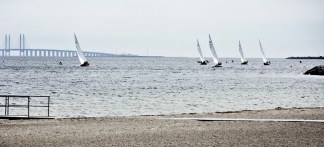
Amager Strand & Oresund Bridge

This time, I got off the train at the CPH airport – near the western end of the long Oresund Bridge from Malmo, Sweden – to take a brief metro ride to the area of Amager Strand, a southern suburb of Copenhagen, to find my last hotel stop before the flight home.  The hotel felt industrial, cold, and confined, so I was driven quickly back out to walk near the beach and enjoy a neighborhood restaurant, the Cafe Phenix – Amager.   Enjoying the sharp sea breeze, I alternately stared at the long line of towering wind generators and the great bridge that carried my train to and from Sweden.  In my brief last stay in this bedroom community of Copenhagen, I returned again and again to the Strand.
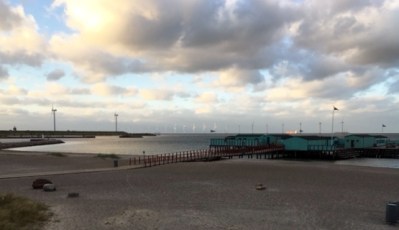
view east from amager

On my last full day of this ScanEst trip, I chose to focus on the great SMK, Statens Museum for Kunst or National Gallery of Art, on the edge of the Botanic and Kings Gardens.  Following a crowded ride on the metro from the Oresund Station to the Norreport Station, I hiked again through the vast grounds.  I had walked these grounds over two weeks before, found the SMK closed, and vowed to return when it was open.  On a gray and misty Wednesday, 31 May, I strolled again past the Rosenborg Castle that dominates the Kings Garden (and pictured in an earlier post), and sat on a bench to watch the many birds in the marshes and ponds of the Botanic Gardens, before approaching the high wide stone steps of the SMK.

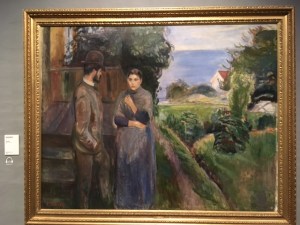
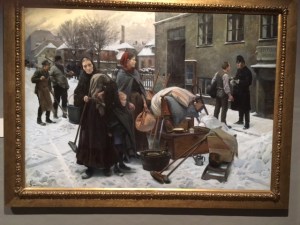
Although weary from days of walking through northern Europe, the rich and immense collections at the SMK kept me moving from room to room for hours.  The premier exhibit was entitled “Nordic Highlights,” an echo of the exhibit on light at Sweden’s Nordic Museum, covering works of Danish and other Scandinavian masters from 1750 to 19o0. The chronological arrangement of these works demonstrated the changes in style and culture, evolving from focus on elegant portraits of aristocrats to representation of harsh country life.  There is also a selection of European Art from 1300 to 1800, and a surprising display of French “modern” art of 1900 to 1930, including works of Matisse, Braque, Modigiani.  My favorites, though, are examples of Nordic social realism in the mid-to-late nineteenth-century works of Munch, Block, Ancher, and Henningsen.  I was delighted to learn that photographs were allowed, without use of flash.
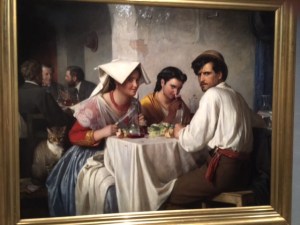
In a Roman Osteria, Carl Bloch, 1866
Lifeboat, Michael Ancher, 1883


I


Summer Evening, Edvard Munch, 1889
Evicted Tenants, Erik Henningsen, 1892


After riding the rails back to my odd industrial hotel, I spent a quiet final evening in Copenhagen, washing and organizing clothes, then walking again on the Amager Strand and dining at my favorite Cafe Phenix.  My journal says:  “Tired and I wanna go home.  Rest my feet.  Feed my cat.”

Thursday June 1st extended by six hours for me, as I flew west with the sun for eight hours to Dulles, then grabbed one more gift from the Travel Spirit as I was able to catch an evening flight back to Greenville airport, find my car and blearily drive home at about 3 AM on my body clock.  It has taken me nearly a month to recollect the journey and set it down here.    I am reminded of one more image from Haapsalu, Estonia, looking out at the Baltic.
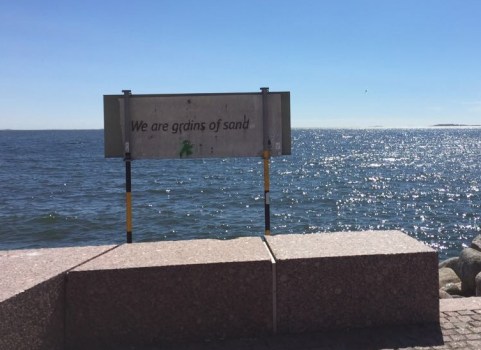
Haapsalu Message

More Discoveries in Tallinn

Occupation Museum, Toompea

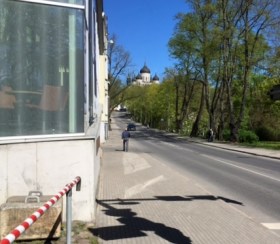
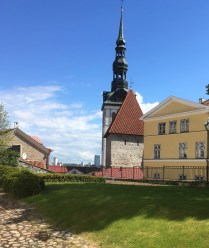
The day after enjoying the journey outside of Tallinn, to Haapsalu, on Tuesday 23 May I chose to concentrate on a visit to the Occupations Museum, a modern glass and concrete building a few blocks from my loft in P. Suda.  Bypassing so many reconstructed monuments to the feudal past, I was drawn to this demonstration of the present-day view of Estonian history.  Crossing Kaarli Avenue in the shadow of St. Charles’ Church, I approached the contemporary wall of glass on the corner of Toompea Street.  I looked up the hill, also named Toompea, and saw the onion-domed Nevsky Cathedral pressing against the blue Baltic sky.  It seemed that the Museum was sticking its thumb in the monument to the oppressive past; or is that the Cathedral’s thumb – or finger – gestured at the clear-eyed exposure of the history of occupations?  Not too distant from both, the square steeple of St. Nicholas’ Church dominates Old Town; build by Gotland Germans in the thirteenth century, St. Nicholas’ was reconstructed after Soviet bombing during WWII.

The museum’s name refers in the plural to occupations, as its exhibits cover the period of 1939 – 1991, from the Molotov-Ribbentrop Pact until the restoration of Estonian independence in August 1991.  Although the Soviets annexed Estonia – and other Baltic states as well as portions of Poland, Finland, and Romania – soon after the Pact, the Nazi armies violated the Pact by occupying Estonia in 1941, after having invaded Poland.  Nazi occupation – with all the forced labor and ethnic cleansing that entailed – ended with the Soviets marching back into Estonia in 1944.  Although the Soviets, under Lenin, had originally granted the Republic of Estonia its independence in 1918, upon its re-occupation in 1939, Moscow chose to re-establish a Socialist Republic (read: colony) until 1991.

The Museum’s exhibits are stark and factual, accompanied by a series of documentary films on monitors above each themed station.  The exhibits emphasize harsh living conditions for Estonians, including slave labor, deportation to Nazi or Soviet camps, and evident genocide of tens of thousands of those deported. One of the most striking images at the Museum entrance are a host of suitcases made of concrete, with metal handles, that speak of the forced deportation – and disappearance – of Estonian residents.  The mood, lighting and stark artifacts are reminiscent of the Holocaust Museums around the world that receive more attention.  On the main floor, one can listen to oral histories of survivors while gazing at simple artifacts and occupier uniforms that demonstrate the dismal life under occupation.  On a lower level, within bare concrete walls, the Museum hosts an exhibition of photos about migrants from Africa and the Middle East to Europe.  Now a member of the European Union, Estonia is being pressured by its wealthier neighbors to accept more of these recent refugees.

Dazed after a couple hours of that fare, I wandered into the sunlight and through Old Town.  I toured the old craftsmen alleys, where the medieval guild artisans labored over a wide variety of products, including weaving, ceramics, leather goods and woodwork.  I had a vague hope of sensing the distant presence of my great-great-grandfather, a cabinet-maker who carried his craft to the New World.  It is tough to visualize the nineteenth-century past that is obscured by the omnipresent emphasis on tourism.  The streets are filled with inns and restaurants, interspersed with old religious and municipal buildings.  So much of the town has been rebuilt, it feels like a Disney facsimile park entitled “Ancient Medieval Town,” with round towers and square steeples and humble monasteries, oh my.


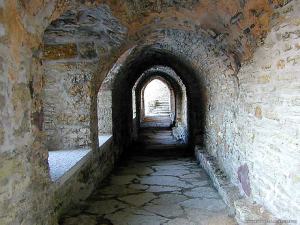
And yet, and yet:  an image rose in my mind, of a young man in simple clothes and a small bag, nervously leaving his home and work, and boarding a wooden sailing craft in the evening, heading out on the Baltic and into the unknown.  At great risk, he left friends and family; why did he leave, and what did he expect to find?  It was a ghostly feeling, but one I trusted.  I see him walking through the narrow cobbled streets, footsteps echoing on the dim heavy walls, briefly glancing behind.  There in the bright mid-day light, I shivered with him.


Then it was Wednesday, midway through my Estonian journey, and I was expecting the arrival by afternoon ferry of my niece who has been studying early childhood education in the Netherlands.  Friend and voluntary guide Roland planned to join me in greeting her, then with his wife join Jenn and I for supper in Old Town.  But first, after dropping off a bag of laundry at a service near my house, I chose to board the infamous Red tourist bus that plies its way around town and its outskirts.  This was a bit of surrender, following the classic tourist behavior, but I was rewarded by an informative overview of the town and outlying areas.  In fact, the bus does not enter Old Town, but provides a well-narrated sense of the breadth and dynamism of the entire city, including the expanding zones of factories, high-rise apartments, and gleaming offices. But it also reveals the growing pains:  blocks of both drab soviet-era residences mixed with older grand homes that have descended into shabby disrepair while  locked in litigation limbo over privatization.  From the rambling double-decker bus I glimpsed the edge of a district called Kadriorg, where the Russian Emperor Peter celebrated his conquest by laying out a vast park and palace in honor of his wife Katerina.

interior, Nevski Cathedral


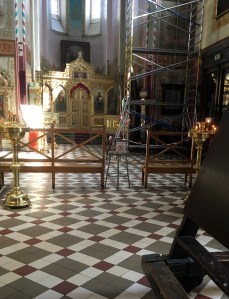
Hobbled by a couple of toe blisters produced by too-new and stiff hiking boots, combined with miles of daily walking, I hopped off the Red Bus in the port area in search of some softer slip-on shoes.  Once-acquired, I rode the bus to the Toompea area, the hill that is crowned by the Russian Nevsky cathedral and by the Dome Church of St. Mary, and surrounded by a large green area.  A glimpse of the Nevsky towers is seen in the photo heading this blog.  I mounted the steep stone steps, past a babushka-style lady begging for alms, into the darkened, gold-clad interior.  A large section in the rear is devoted to the sales of mass-produced religious icons.  Interior photos are prohibited; I surreptitiously snapped a couple on one side of the chapel, where scaffolding and workmen revealed the ongoing maintenance of this century-old symbol of past Russian dominance and of the weight of the Church behind the fist of imperial power.  The gold cladding on the altars was enabled by the marching of soldiers’ boots.

I walked to the offices of Tallinn’s premier private language school, and interviewed its director.  I had mentioned in passing to Roland my random thought of teaching English in Estonia, and he set up this meeting.  A kind, meticulous, and well-spoken lady, the director invited me to give a brief teaching demonstration the next day, something required of all the institute’s teachers.  I was tempted, but declined; my work is nearer home, where I teach English to Latino immigrants.  I then met Roland and rode the tram to Terminal D to meet niece Jenn.  We had not seen each other in a few years, though I kept up with her teaching career through my sister.

At Balthasar’s, Old Town

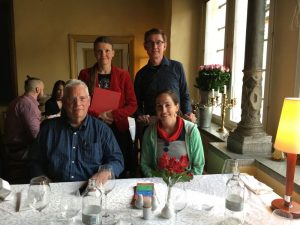
After settling her in an apartment next to mine at P. Suda – its availability an accident or work of the spirit? – we met Roland and his wife Merle at the sumptuous Restoran Balthasar in Old Town.  This was perhaps the most elaborate meal I had on my entire ScanEst journey, and we enjoyed exchanging views on education and child development.  Merle, in addition to mothering three fine children, is a published writer, a part-time teacher, and a caretaker for a ninety-five year old defector from the Nazi army.  She gave me a copy of her beautiful book entitled “Kingitused,” or Gifts.  Many of the photo illustrations were provided by her older son, Rafael.  I believe she and Roland are dedicated to offering gifts to friends and strangers.


Palace and Visitor, Kadriorg

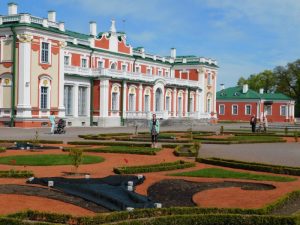
On Thursday, 25 May, Jenn and I directed out attention to the immense Czar palace and the art museum complex in the parks of Kadriorg.  We spent most of our time at the Kumu Art Museum, the largest and most impressive of Estonia’s many art museums.  It houses the best representation of Estonian art from the 18th century to the 1990’s, and the works provide a visual history of changes in artistic sensibility over those centuries, from realistic representation of the traditional countryside to impressionistic and modernist works influenced by the major schools in Western Europe.  My niece was able to spend more hours there than I, as my raw, blistered toes drove me to retreat to the apartment for a couple of hours.

Meeting her at Vabaduse Valjak – Freedom Square – in late afternoon, we wandered Old Town in search of a restaurant, wanting to avoid the most blatantly touristic.  We at last settled on an unusual place on the border of Old Town and the modern dynamic city, called Manna La Roosa.  The interior decoration, the eclectic clientele and menu all give this place a Bohemian feel.  We felt quite content with our choice as we strolled home to P. Suda in the mid-evening twilight.

Two locations highlighted our last full day, Friday, in Tallinn.  First, I accompanied Roland and Jenn to her appointment to speak with teachers at a private pre-school.  Jenn quickly settled into an extensive sharing of views on early-childhood development in one of the classrooms, one teacher providing the necessary translations.  Meanwhile, as the irritation in my molar and gum had worsened, dear Roland took me to the top clinic in Tallinn, and talked his way into a nonexistent appointment space with one of the most talented dentists in the country.  As we were waiting outside the dentist’s office, Roland commented: “We’re really lucky; it’s Friday and she is headed off to vacation after this.”  I looked at him, smiled, and said: “Luck?  I don’t think so, Roland.  Trust the Spirit.”  He gave me a bemused look.

St. Nicholas, Tallinn

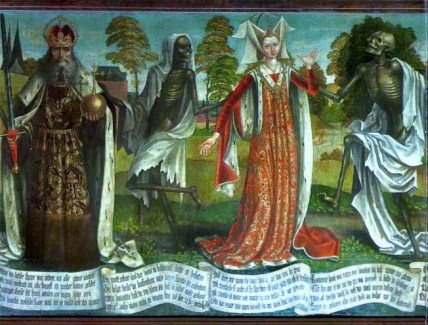
Then, reunited with Jenn and my gum infection tamed, Roland talks his way into the museum and concert hall within St. Nicholas’ Church, although the museum is officially closed in preparation for a concert that evening.  Roland knows the concert-master, who he greets, then takes us to the lower level to view what is perhaps the most precious medieval painting in Europe: the sole remaining remnant of Bernt Notke’s Danse Macabre.  Completed in the fifteenth century, only a fragment of the original 30-meter work is preserved; an earlier version of Notke’s work, accomplished in Lubeck, Germany, was destroyed.  This striking tapestry depicts dark skeletal images of death dancing with lords and ladies.  Several other intricate medieval altar-pieces are on display at St. Nicholas’.  Contemplating these dark medieval views of mortality and salvation felt like a fitting manner to wind down my once-in-a-lifetime visit to this ancestral land.


Central Section, Danse Macabre


At Home in Tallinn, Discovery in Haapsalu


Leaving Finland

After all the planning and anticipation, the trip from Helsinki to Tallinn seemed routine that Saturday, May 20.  Two different tram rides, and a few blocks walking, and I arrived at the ferry terminal on Katajanokka peninsula in Helsinki.  As I observed passengers gathering in the terminal and then boarding the multi-deck ship, I realized that this journey was a routine commute for many Finns.  An early-afternoon sailing for a two-hour jaunt across a narrow portion of the Baltic, it seemed that all of Helsinki was starved, as they rushed the dining area before the craft had left the port.  Concerned about possible seasickness, I went directly to a seat.  But the sea was smooth and the voyage uneventful.  A couple rows in front of me, a rangy young lady laden with a bag full of tennis rackets and accompanied by an equally-athletic man led me to imagine that she was one of the aspiring tennis pros of the Baltic States who are currently breaking into the majors.  But I was not bold enough to ask her, not wanting to be labeled the dumb American tourist that I was.  (The subsequent 2017 women’s champion at Roland Garros was Jelena Ostapenko, from the Estonian neighbor Latvia.)

The luck of the traveler did not seem to be present upon landing in the port of Tallinn.  I walked away from the terminal in record heat, approaching 80 degrees F, or 26 C, where the average for May is usually 18 C, or 64 F.  A couple of days before, Swedes and Finns were celebrating the advent of 20 C temperature.  I found a tram stop in the nearby highway outside the Old Town, but determined that the line that stopped there did not head toward my destination, an old house on a little street named Peeter Suda.  I decided to walk in the general direction (south) that maps had indicated, and ask directions.  I repeatedly stopped and asked directions; many helpful people tried to steer me in the correct general direction, but most had no idea where P. Suda lay.  I continued to disdain the the idea of taking a taxi, and plunged into the winding streets of Old Town, stumbling over uneven paving stones with my roller bag in tow, weighted down by my loaded backpack.  The streets were lined with cafes crowded with merry Sunday tourists – many likely off the boat from Finland – as I struggled onward.  Someone directed me to a main road passing the eastern edge of Old Town, named Parnu Maantee – Parnu Road.  I reached that busy modern street, and proceeded to turn the wrong way, perhaps a hundred meters from my street.

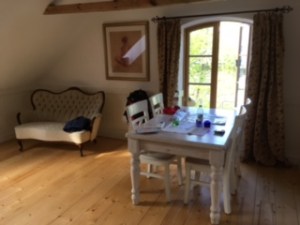
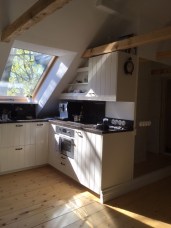
One and a half hours after landing at the port, and circling the neighborhood a couple of times, I found the old three-story house, on shaded P. Suda and just off of Parnu Mnt., and climbed the creaking wooden steps to the third floor.  There was my host, a bright and energetic lady, concerned but glad to see me arrive.  I was weary and warm, but home.  My host graciously showed me the main features of the place, including the marvelous automatic espresso machine.  She briefly explained the history of this family home; her grandmother as a young girl had to flee the house in fear of Nazi or Soviet bombardment during WWII.  The wooden structure survived and the interior seems artfully remodeled.  When I shared my interest in taking day trips outside of Tallinn, my host recommended the western seaside town of Haapsalu, a family favorite.

Light in P. Suda

After my host left to return to her family in a modern suburb, I briefly unpacked my goods and rested my feet.  Late afternoon shadows had creeped over the house as I wandered back onto the city streets.  Not feeling ambitious, I crossed the main boulevard to a Reval Cafe on a far corner of Parnu Mnt.  I lingered there over deli-style salad and sandwich, savoring the ineffable reality of being in my ancestor’s home town.  I walked the neighboring streets of “modern” Tallinn, but had no interest in exploring the hectic lanes of Old Town that evening.

The next morning, Sunday 21 May, I followed email instructions to the location of a Quaker worship group.  Through the website of an international Quaker organization, months before traveling, I found the names of Quakers in some of the towns I would be visiting.  Roland Anton Rand is the leader of Tallinn’s growing Quaker Worship Group, and he had invited me to join them this Sunday.  They do not gather for worship every Sunday, but he called a few attenders in expectation of my visit.  A few blocks’ walk in the chilly and bright morning brought me easily – compared to Saturday’s hike through Tallinn – to the building on Kaarli Puiestee (Charles Avenue) where the Group leased a meeting room.  I noted the room was in offices of an LGBTQ organization.  A young man – 20’s-30’s? – approached with his bicycle about the same time I found the address.  Then a young lady, and finally a 40-ish slender man in glasses.  The latter was Roland, who would gracefully shape my experience in Estonia.

The avenue is bordered by a large green space and watched over by an immense church – Kaarli Kirik or St. Charles (Lutheran) Church – built in the 19th century to replace a much older wooden sanctuary that was commissioned by Swedish King Charles XI in the seventeenth century.  Friend Roland had spent some of his earlier faith energies focused on that space.

Our little worship group settled into the austere office space and introduced ourselves and our reasons for being there.  We then celebrated silent worship for about 45 minutes, with two people speaking in ministry, one in Estonian and one in English.  After some further social conversation, we dispersed, but Roland offered to accompany for most of the afternoon.

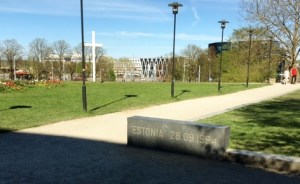
Before lunch at one of his favorites,  Cafe Josephine in the Old Town, we visited a sparse memorial on a hilltop to the north of Old Town, overlooking the harbor.  The spot commemorates the sinking of the ferry MS Estonia in 1994, while en route overnight from Tallinn to Stockholm, with the loss of 852 lives.  Most were Swedish or Estonian.  Though little-known in the USA, the ship disaster remains the worst in peacetime after that of the Titanic.

MS Estonia Memorial Park

Near the memorial, on the same hilltop, Roland and I approached a heavy, moss-covered concrete bunker, a remnant of WWII Nazi occupation.  It has been converted into a underground cafe, bar, and art gallery.  The young lady from the Quaker worship group was exhibiting some of her paintings there.  They all seemed to represent her musings on sexuality; she had only recently outed her lesbian identity.  She is representative of an Estonian generation struggling to establish new identities in the fragile post-Soviet independence era.  They face an older generation that is still fearful of breaking out of the gray and rigid conformity of the authoritarian past.

As we wandered back through the streets of Old Town, Roland pointed out various buildings of note, including the school where his younger son, Raimond, studies and sings in the choir.  It is the Gustav Adolf Grammar School established by Swedish king Gustavus Adolphus as the Reval Gymnasium in 1631.  He pointed out a building where he used to live, until he was evicted by the town council in the confusion of “privatization” after independence in the 1990’s.  While lunching at Cafe Josephine (Roland knows the owner,  just as he seems to know just about every other person of note in Tallinn), Roland related a bit about his personal history.  When in his teens, and while still under Soviet rule, Roland became known as a talented musician (piano and organ).  The Soviet authorities recruited him for a band of musicians that traveled to various countries to further the Soviet’s propaganda objectives.  This included the African nation of Mauritius; in 1987, at the age of 21, Roland slipped off from the group’s handlers and successfully sought asylum in the U.S. Embassy.  The Soviets threatened him and his Estonian relatives, but Roland arrived in New York City in November 1987.  Fearing reprisals, he remained there, establishing a business in recording and producing, for several years.  Contact with his future wife, Merle, finally drew him back in the mid-90’s.  Today he is an established producer of documentary films and television ads, and continues to assist with major concerts and peace celebrations.

On Monday, 22 May, I took a mid-morning bus across the countryside to Haapsalu.  I did not know exactly why I was going there or what I would see, but I followed the inner guide leading me that way.  I was not disappointed.  After staring at dairy farms and compact country houses from the bus for two hours, we arrived at the little bus depot – and old RR station – on the edge of Haapsalu.  At the suggestion of a lady near the depot, I followed a well-defined walkway that arced along a marshy bay on the verge of the Baltic.

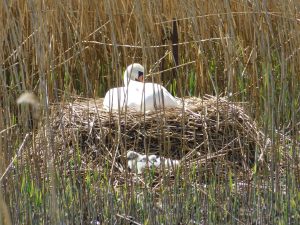
On the walk to Haapsalu

Practically alone, I lingered on the walk to absorb the peaceful view of wild swans nesting in the marsh and bobbing on the sea.  If I had any lingering doubts about my purpose for traveling to this small town, they dissipated with the breezes. I followed the walkway for about a mile and then joined the quiet lanes of the town.  I passed several attractive inns and spas, in uniform old wooden houses, on my way to the old town center, dominated by the ancient cathedral and castle established by the Catholic Church in 1279.  They called themselves the Bishopric of Osel-Wiek, under the joint authority of the Pope (through his archbishop in Riga) and the Holy Roman Empire.  Riga and the surrounding Latvian populace had been “Christianized” in the preceding 100 years through crusades impelled by Rome.


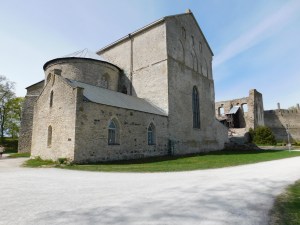
Haapsalu Church/castle

As I wandered the castle and the sanctuary, a working museum, I awakened to a deeper  understanding of the traditional partnership of church and state in medieval Europe.  The Bishopric was an ecclesiastical state, with the priests or canons overseeing religious, political, and social norms and practices.  In the remaining structures, it is difficult to distinguish the military castle from the spiritual sanctuary.  Both are museums today.

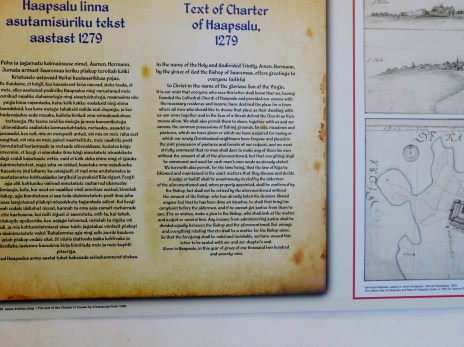
A plaque on the wall of the castle museum translates the original Charter that established this religious state in 1279; the recitation of the rights of the canons and of the residents echoes that infamous “Doctrine of Discovery” that would permeate European colonialism of subsequent centuries:  all rights of usage adhere to those who are confessed Christians, while property would be simply taken from heathens.

Bishop Charter in Estonia

I had travelled over four thousand miles from home, and stared at the same ideology that drove the conquerers and colonialists to America, providing a sanctified framework for oppression and slaughter of the native “aborigines.”  We lamented that history in my home Quaker Meeting; why should I be surprised to find the same framework at the far end of Northern Europe?