
How did this young American graduate student find himself leaning over the edge of a steaming volcanic crater with Indonesian friends? Did he truly sit in a Central Java village, struggling to fashion some mud bricks under the watchful eye of a village elder? Why did he find a trim Indonesian marine pointing a rifle at him on the wharves of Surabaya? Was that self truly an earlier version of this aging soul, or a whisper of his imagination? It is so long ago, decades, I can imagine this happened to someone else. Except the spirit guide I found there continues with me.
In the summer of 1967, I scraped together a small sum to voyage to Southeast Asia for the first time. I had completed one academic year of SE Asian studies at Yale Graduate School, and was anxious to bring the textbook and lecture data to life. It would bring me my first vision of the Luck of the Traveler. The airfare consumed a large portion of my funds, so I was at the mercy of local hospitality for most of my journey. Yes, children, this is way before AirBnb and smartphone apps.
The American War against Vietnam – the cause of my interest in Asian studies – was hot, but I managed to start my journey with a week’s stay in Saigon. I climbed on a classic Pan Am jumbo jet in San Francisco, and barely slept for the day’s travel across the Pacific. The bar in the upper First Class cabin was filled with hardened journalists until the lumbering aircraft began its circular and steep descent to Tan Son Nhut Airport. The unusual approach was intended to avoid antiaircraft fire from paddies just outside the city.
I stayed that week at the house rented by a friend from college, who was conducting “research”, as a civilian working for a defense-funded foundation. Early one morning in Saigon, I tried to accompany him on a private flight out to the Mekong Delta, but the Air America pilot would not take me on due to limits on total weight. I wandered the besieged city, and watched red rain of lead from gunships from our rooftop at night. My trip – and my life – almost ended abruptly when I discovered a large fragment of glass buried in a bowl of rice at a restaurant near the main drag of Tu Do (Independence) Street, now named Dông Khoï. Probably the peak moment of that week in Saigon, was an interview with a Buddhist monk about their protests of the war; I had walked to a temple compound of monks and managed to obtain an appointment with a follower of Thich Nhat Hanh, who had recently been banned from his home country for his peace activism.
I then flew on to Singapore, where I stayed a few days as a guest in a university dormitory. There I met another young American man, and together we hitchhiked across the causeway to the Malayan Peninsula, and caught rides – first on the back of an open-bed truck, then in a VW Beetle with a young Chinese couple – to the capital city of Kuala Lumpur, or “KL.” The Chinese couple spent a large part of the journey complaining about the Malaysian government’s policy of favoring the “bumiputra,” or native Malays, who tended to be less educated and had been treated with prejudice under the British colonialists. The ride gave me an up-close view of the smoldering racial divide, first engendered by the colonial divide-and-rule practice.
Following another few days’ stay in KL – sleeping on the floor of a university dorm room – I caught a public bus headed over the mountains to the less-developed east coast of the Malayan Peninsula. In the first stroke of travelers’ luck, on that bus trip I befriended three Americans serving with the U.S. Peace Corps in the federal state of Pahang. As we swayed and bounced on the precarious mountain highway, they invited me to stay with them in the town of Pekan, seat of the Sultan of the State of Pahang. When they learned I was a competitive tennis player, they set me up to play with the Sultan at one of his palaces. A very large man, the Sultan required that I hit the ball near to him, as he would (or could) not chase around the court. After about 45 minutes of awkward play, on a well-maintained clay court, we sat at a courtside table to enjoy some fresh pineapple juice.
Later that night my spirit guide abandoned me: after sharing a typical meal with my Peace Corps friends at a local restaurant, I was laid low with terrible intestinal distress. My friends aided me with a local concoction, a bitter white liquid, to slow down my system. It worked, slowly.
After a couple days’ rest, I shakily climbed a bus to Singapore to catch a flight to Jakarta, the main objective of my journey. An associate from Yale had referred me to some Indonesian students and journalists he knew, and I was pleased to see a group of them waiting for me at the old Halim airport that is now replaced by Soekarno-Hatta International Airport. I was thankful that they guided me through the sweltering crush of anxious Indonesians and expatriates, waiting at the arrivals gate outside of customs. That scene had not changed much when, two decades later, I experienced the same crowds when I arrived in early 1986 to work as a financial consultant.
I stayed at the Jakarta home of Gunawan, one of these young journalists – who would later become editor of a leading local magazine – who introduced me to the simple life without indoor plumbing in a typical middle-class house. On the first day of my visit, I joined my student friends at an anti-corruption, anti-Suharto rally in the streets of Jakarta, sweating in the large crowd and listening to the speeches from student leaders. General Suharto had recently taken over power from the independence leader and first President Sukarno, but the students and intellectuals in the streets saw that corruption continued. I was thrilled to visit, along with my new friends, the home of author Mochtar Lubis, whom I had studied a bit at Yale. Lubis served as kind of a godfather to this gathering of young intellectuals; in addition to publishing several novels, he was a leading anti-establishment journalist, and was imprisoned for years for exposing corruption in Sukarno’s government. He came from the Batak ethnic group, a predominantly Christian tribe in central Sumatra. (My Indonesian language teacher at Yale was also Batak.)
Then our group of students and aspiring journalists headed out on the road, hitchhiking toward the West Java town of Bogor and the slumbering volcanic peak called Gunung Gede (Big Mountain). My Indonesian friends – many of whom were of mixed Chinese descent, but using Indonesian names due to prevailing ethnic prejudice – explained that they were part of a solidarity club called Student Nature Lovers (Indonesian acronym: MAPALA). The group organized outings into the Javanese countryside in a self-cleansing effort to prepare for ongoing protests against political corruption. Arriving at the foot of Gunung Gede in late afternoon, our group headed up the well-trod trail for hours in the cool jungle night. Gunawan and his friend Soe Hok Gie explained that they wanted to avoid climbing in the stifling jungle heat of daytime. Towards eleven or midnight, we arrived at a large rustic lodge, mostly bare of furniture. After lighting a fire against the mountain chill, we quickly sorted ourselves around the wooden floor, whispering ourselves to sleep.
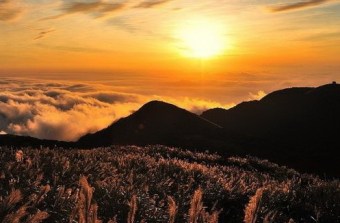
About thirty minutes before dawn, we gathered ourselves and headed back up the trail toward the crater. We arrived at the top in the gray dawn, looking down on billowing clouds and the steam rising from the deep, rocky crater. Big Mountain was dormant but alive. Our group, full of noisy chatter during the long night hike, remained reverently silent as we wandered the gravelly peak. Gie picked a small, dark-green leaf of a solitary bush, and explained that it was only found there and was believed to have salutary health benefits. It tasted bitter. There is not much to do on a volanic peak, except to meditate, gaze into the clouds, and be thankful for the trek. We silently descended to the teeming base. Two years later, I was saddened to learn that friend Gie had been overcome by the poisonous gas, and perished on the crest of a similar crater on Mt. Semeru. A much-loved young scholar, nature-lover, and political activist, Gie has been the subject of several memorial stones, books, and a movie based on his posthumously-published journal.
While others returned to Jakarta, Gunawan and Gie accompanied me to Bandung, capital of West Java province, long considered the “Paris of Java” due to its cooler climate and pleasant setting among mountains dotted with tea plantations. My friends were particularly proud of the Bandung Technical Institute, calling it the “MIT of Indonesia.” The city gained international renown as the site of conference of unaligned Asian and African countries in 1955. Although the city is marked by clean, modern architecture, the image that remains with me is of a tall, destitute, and naked beggar who wandered across a busy intersection in midday, desperately trying to cover his private parts. The surrounding pedestrians turned away in shock, shame and pity; the Indonesian culture carries a puritanical strain that goes deeper than its Islamic veneer. While I saw countless unwashed and handicapped people on the streets of Southeast Asia, the total shame of that naked man is burned in my soul.
The main objective of my journey was Central and East Java, scene of wholesale massacres that followed a failed coup in September 1965, less than two years before my visit. The military leaders who prevailed against the coup forces blamed the local communist party for the attempt; the military then united with radical Islamists to exact revenge on their alleged enemies. I had been studying the incident – generally referred to as the Gestapu, an Indonesian acronym for the September 30 Movement – in the quiet halls of graduate school, and hoped to learn more on the ground. So, after Bandung, I boarded an old Dutch-made railcar (kereta api in Indonesian, literally “fire carriage”) headed east to Jogjakarta, enduring nearly 12 hours on a hard wooden bench. Scores of vendors boarded the train at each station stop, bearing snacks and trinkets in battered bamboo baskets. The grinding hours in a fire carriage were relieved by panoramas of rice-paddies, guarded by silhouettes of steep green mountains, and punctuated by startling depths of steep ravines that we crossed on ancient wooden trestles.
Perhaps thanks to the spirit guide, I met and chatted amid the train’s clamor with a Dutch priest who was serving as a missionary in a Javanese village. He was one of the few Westerners sweating and swaying in the third class car. He explained that, as a youth, he wanted to conduct missionary work in Asia; “since there was nothing like the Peace Corps in the Netherlands, I signed up for Catholic priesthood to get me there,” Pater (Father) Janssen explained. After some years working in China, he and his brethren were ejected after the Communist revolution there, and he landed in Java.
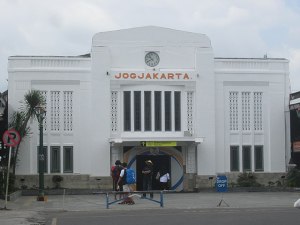
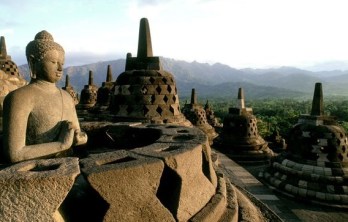
As I had no fixed reservation in Jogja – my sole objective was to view the Borobudur monument (partially pictured at the head of this blog post) before exploring East Java – Pater Janssen invited me to the hostel where he planned to stop overnight before the road trip to Widodaren, the village base of his mission work. Accepting, I enjoyed a pleasant evening and a hearty breakfast of nasi goreng, fried rice mixed with egg and onion and bean sprouts. The following day, I headed out early for Borobudur; in those days it was quiet around the massive shrine to the Lord Buddha, except for the usual scattered vendors of souvenirs. The scarcity of tourists may have been due to the recent waves of violence in the region. I slowly mounted the nine levels of stone platforms of diminishing size – in a pyramid-like structure – stopping on each platform to walk around the stupas (hollow stone monuments – see the photo heading this post) containing Buddha statues. Built in the eighth and ninth century, at the height of Indian influence in the region, the relief carvings on each level reflect a mix of native and Indian spiritual concepts. The vast man-made mountain is set on a hill, and as I climbed I gazed out at the surrounding Javanese plain, enjoying soft breezes and silence. The structure reflects the pattern of building “sacred mountains” that are found in South Asia and throughout Southeast Asia, most famously at the partly-destroyed Angkor Wat of Cambodia. The Borobudur complex has been restored several times, and is listed as a UNESCO World Heritage Site.
Pater Janssen continued his generosity to this young graduate student by inviting me to visit the village of Widodaren with him. The sprawling village lay just over the provincial border in East Java, near the Solo River and the town of Madiun. On the four-hour jeep drive to the village, the priest explained a bit about the politics of Catholic missions; while his main objective was to build a new school and clinic in the village, in order to get the funds from the Church, he had to build a church. All were in process as we spoke. When I explained my interest in local recollections of the mass violence in 1965, Janssen cautioned me: “You will find that most villagers are ashamed of the outburst and reluctant to speak about it with anyone. Be careful.”
The elderly Javanese man introduced as the village head (kepala desa, or kepala kampung) was gracious, and invited me to stay in a small house near his own. In my week’s stay, this village elder led me around the many sections of Widodaren and explained the rhythms of its rice-centered agricultural life. Javanese is a complex dialect, and the many ethnic groups are linked by the national Bahasa Indonesia, a simplified Malay-related tongue first adopted by the coastal tradesmen and later promoted for national unity. So in speaking in the Bahasa, an official state dialect, I was missing the deeper innuendoes of the indigenous language of Java. My guide also glossed over the differences among the several sociological, and religious, classes coexisting in all Javanese villages, that I had learned in my graduate studies. When I asked about these, the “pak”, an honorific term for elder males (from “bapak”, papa), emphasized the unity of the entire community, or rukun kampung. This reflects the centuries of efforts to balance the mixture of native Javanese culture with Hindu, Buddhist, Islamic, and European imports; varying adherence to the different beliefs has exacerbated the evolving social conflicts.
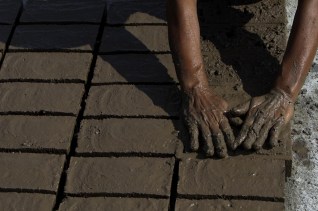
Of all the local industries and crafts that Pak proudly showed me, at this distance in time I recall most clearly the brickmaker. Seated in the workyard next to his house, the lean and taut craftsman fashioned the bricks in the old way, packing a four-square wooden frame with thick mud and slowly lifting the mold, allowing the earthen squares to dry in the tropical sun, then repeating over and over. Smiling, the village head and the brickmaker invited me to try imitating the craft. After several failed tries, in which the mud collapsed in a puddle when I struggled to lift the heavy mold, I finally managed to create four fine-edged blocks. I smiled with pride when the patient craftsman pronounced “baik sekali,” or very good, in a guttural voice. I sat next to the master in the hot sun, focussed only on that reddish-gray mass of Javanese earth.
One evening, late in the week, sitting by a fire in the headman’s compound, with a few other elders, I tried to ask about their experience of the social upheaval of September 1965. With great embarrassment over the breakdown of social order, Pak quietly explained that the failed political coup, and the army’s revenge afterward, had sparked a wave of revenge killings, a settling of scores among different religious and social factions, partly led by “fanatic muslims” against the more traditional Javanese. The memories of the countless headless bodies choking the nearby river still burned brightly among the survivors, but shame and fear suppressed open discussion except in the darkness of a village head’s home, with an outsider. Feeling their pain and shame, I stopped asking questions.
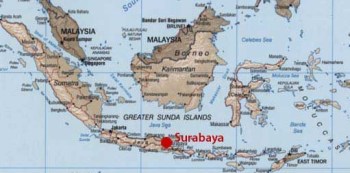
Then I was off on a three-hour bus journey to Surabaya, a busy port city on the north coast. Ports along the north coast of Java served as entry points for the dissemination of all the varying cultural and religious beliefs carried by traders and holy men on sailing vessels from South Asia and the Middle East. After the port of Jakarta, Surabaya is the largest and most-developed on Java. My brief stay in the city was marked by two very different events. First, at a restaurant I was introduced to an Indonesian army general who lived in the area; when he learned that I had played tennis for my college team, he invited me to play at his club. The club was a luxurious refuge from the hot, dirty city, with well-maintained grass courts. I had never played on grass courts, only paved and clay. I was surprised how fast the balls skidded on the grass surface, and my timing was poor. Though I was sorry not to be more competitive, the general seemed to enjoy the outing and we shared drinks at the club afterwards. So I had experienced two very different moments of “tennis diplomacy” on this journey.
At the time (late-July 1967), urban race-related riots were raging in U.S. cities, most notably Detroit. Sitting in a comfortable club in Indonesia, I was bewildered by the extent of the fires and violence back home. Although the general and his friends peppered me with questions about it, I had no informed answers. I was stunned that I knew more about the history of violence in rural Java than about the causes of American urban unrest. Scores of people died, hundreds of structures were burned down. The emotional impact caused me to rethink my career direction, and I later devoted years of volunteer action in U.S. “inner cities.” I still am not certain I understand the origins of America’s mid-century riots any more than I understood the causes of revenge killings in Java. However, the 1982 Australian film, The Year of Living Dangerously, uncannily communicates the feeling of communal tension during the 1965 uprising.
The last afternoon in Surabaya, I wandered down to see the great harbor. When I was a child, I loved to accompany my Dad to see the fishing harbor in Gloucester, Mass., where the white gulls swirled and cried around the seaworn fishing vessels as they unloaded their catch. He had served in the Navy, and continued to be fascinated by the sea. So I felt free and comfortable to wander onto some of the large wooden wharves in that Javanese harbor. Among the rusty freighters, I noted a couple of gray naval vessels bristling with cannons and antennae. While gazing seaward, I heard a shout behind me, on the wharf. I turned to see a uniformed Indonesian guard pointing his rifle toward me; he yelled at me in Indonesian: “Not allowed. Get out.” Stunned, I must have stood still for some minutes, and the soldier continued yelling at me and aiming his gun. Trying to remain calm, I raised my hands and walked slowly off the dock. My back felt the barrel of his gun pointed at me, and I awaited the rifle report and the blow to my back. It never came; I just kept walking, amazed and thankful that he did not pursue me. I later learned that the Soviets, who provided military assistance to the Indonesian government, were using the harbor for some of their Indian Ocean fleet. The Cold War extended to these islands.
The next day, I took an overnight train back to Jakarta, and soon after I boarded a flight toward home. I would return to Indonesia nearly 20 years later, to work as a financial consultant, with my family life in shambles. That is a story for another time.

 Following the Spirit