Traveling Inward

Central Section, Danse Macabre

From late February to May of 2020, the foundations of the Western developed world were shaken and weakened.  Citizens of the United States and Europe seemed to respond first with denial, then shock, then with slow, chilling recognition that the routines and rules of daily life were disrupted or broken.  The recognition of the new truth of our existence moved like a slow wave, and millions were stuck in denial while millions more were forced to stare into the maelstrom by economic and physical necessity.  We thought that September 11, 2001, changed everything;  it did for the minority directly hit by the physical destruction, the temporary market downturn, and the ensuing military response.  But the COVID Wave is sweeping away much of what we assumed was fixed, stable.

Posts on this blog have covered some of my journeys outside of my home country.  This one confronts the inward journey caused by the forced solitude required by a mandate to maintain “social distance”, to stay at home.  I started limiting social contact in mid-March, and like many others began to explore the technology of web-based conferencing.  Mingling with large numbers of people was dangerous; touching other humans was dangerous; journeys outside the home were limited to essential visits to grocery stores.  Restaurants, churches, sporting events all closed.  Political rallies were cancelled.  People scrambled to purchase essential supplies, and in their panic, hoarded excessive amounts of paper products, disinfectants, and medical protection gear.  The media was filled with stories about scarcity: of face masks and scrubs (“PPE”, personal protection equipment), of sanitizer, of ICU beds.  Small riots erupted, led by those doubting the need to pause.
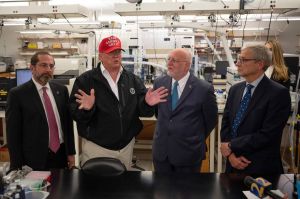
 

The drumbeat of grim statistics became the background noise on the media: virus-induced infections, hospitalizations, ventilators, deaths.  Politicians loomed in front of cameras to give their daily briefings, which became monotonously repetitive: “millions of virus tests will be shipped next week;”  “we’ve got to flatten the curve of hospitalizations;”  “just fourteen more days and we can open this beautiful economy back up.”  Photos and news clips showed empty spaces and long lines for testing and food banks.  The president scurried to photo ops at medical laboratories and hospital ships.  And the deadly stats kept climbing.

The frantic pace of a post-industrial, tech-savvy society just came to a dead stop. Millions of extraverted, FaceTiming Americans and Europeans and Asians stared at the walls and their screens and wondered about their food supply and childcare and income.  People with stock investments lost a chunk of their wealth.  Avid churchgoers wondered how they would continue the facade or the substance of their worship.  Some forced to sit at home started online courses, picked up long-deferred reading, became reacquainted with their children’s idiosyncrasies.

For an introvert like me, the quiet alone time seemed a blessing wrapped in a fearful blanket of uncertainty.  I would practice my Qi Gong; finish reading those four heavy volumes sitting near my bed; stream all those old movies for a second or third time.  But I missed visiting my grandchildren. I took long walks, waving at the many neighbors trying to accomplish the same.  I started preparing my gardens though the April chill precluded much vegetable planting; I researched the cold-tolerant early flowers.  Pansies and poppies anyone?  I am comfortable listening to an inner voice — just not all the time.

But many days were filled, not with an inward journey, but with preparations for increased hours of online tutoring and providing meals for the growing homeless population, and with online Zoom conferences with Quaker committees.  Some fellow Quakers grappled with worshipping by teleconference, trying to muster a sense of the Spirit in the silence trembling across miles of fiber-optic cables.  Can we summon the Holy Presence, the Shekinah, while staring at a computer screen?

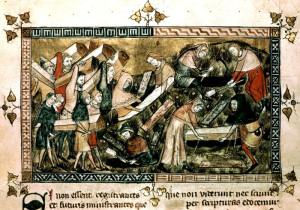
By late April and early May, commentators endeavored to imagine a “reopened” world.  Would we all go back to the same pursuits as in pre-COVID times?  Would the sudden disappearance of noxious carbon and methane fumes be but a blip in our steady march toward habitat destruction?  Leaders preached about “bringing back the good times.”  Fights broke out in grocery and fast-food lines, as some lectured others about mask-wearing and social distancing.  Rather than seeing a general unification against the insidious unseen enemy, old fault lines were reopened with mortal anger:  “Believe the scientists” was opposed by “It’s a liberal hoax.”  Those who turned to the old accounts of historic pandemics, from the fourteenth-century Black Death to the early twentieth-century Great Flu Epidemic, noted disturbing parallels:  anger, riots, denial, and resurgence caused by premature return to social mingling, now called “opening up.”  Camus’ The Plague noted officials’ repeated denials until the bodies in the streets belied them, followed by closing off the city walls.

As I write this in May, doubt and fear rein supreme.  I tried to emerge from isolation at the end of April, after six weeks of isolation, by visiting my son and youngest granddaughter.  Only to find out two days later that my daughter-in-law’s place of work, a nursing home, reported a new case of the coronavirus.  So I retreated back into self-isolation, ordering more books and home supplies.  We will not ever be “the same” as before.  But we cannot imagine the new world.  We wait for the scientists to save us with a vaccine or a cure.  While some of us deny that this is really happening.

We see an ugly resurgence of nationalist anger against Asians, making the foreign “Other” a target of our fear since we cannot see the microbe that brings the pestilence into our lives.  I doubt people will collectively “learn a lesson” from our myriad fatal errors in confronting the tiny beast;  it is tough to maintain Spartan vigilance when times are easy.  When the simple act of wearing a protective mask is seen as a sign of liberal politics, how will leaders convince taxpayers to pay millions for defending against the next pandemic?  For there will be one.
Finland Interlude

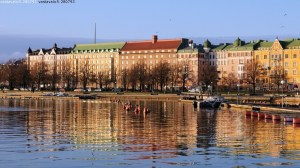
View of Promenade of Merikatu/Merisatama

While planning this 2017 ScanEst journey, I scrutinized city maps to locate the best public transit routes from point of landing to temporary lodging.  Typically, the lodging sites – such as AirBnb or Booking – have brief guides for traveling to your chosen room or apartment.  But I also found that each city had online guides to its transit system.  Somehow, the public transit directions to my apartment in Helsinki, on a street named Laivanvarustajankatu, seemed complex and conflicting from the online sources.  The host/owner’s directions were not much better.  But I enjoyed working on the multisyllabic pronunciation of that street, or -katu.

But when I landed at Helsinki’s airport midafternoon on Thursday, 18 May, the mystery was dispelled and the answer was simple.  When I bought a few Euro at the Monex counter – yes, I was away from national Krone and Krona to the Euro – I told her I needed to get to the central Metro station in a district called Hakaniemi, famed for its old market building.  From there I was fairly confident of the correct tram to take. She promptly directed me to an expansive yard of bus stops just a short walk from the airport building, and to a bus #215.  This is a local bus, but I appreciated the slow journey through orderly suburban neighborhoods, with schoolchildren hopping on and off to get to their colorfully-painted homes.  I was once again on alert, absorbing all I could of the rhythms of speech and lifestyle of another country, under the bright Nordic sky.

I traversed the city from the far north side to the south, to a district called Ullanlinna well to the south, close to the shore of the Baltic, and near the peninsula called Katajanokka, where I would take a ferry to Tallinn in about 48 hours.  I changed from Bus 215 to Tram 3 at Hakaniemi station, and asked the tram operator to advise me when to get off near an R-Kioski on Tehtaankatu, a couple of blocks from my reserved apartment.  After winding through old city streets for about ten minutes, we arrived at the stop.  R-Kioski’s are a Finnish version of Seven-Eleven, complete with rotisserie hot dogs and cold cases of soda and water.  My landlady/host had directed me, by email, to pick up my keys to the apartment at that store.  After showing ID, the clerk handed me an envelope with the keys; when I asked him to steer me to Laivanvarustajankatu, he shook his head and said:  “Only give you keys; I cannot give you directions.”  Service not included.  Convenience store clerks all get the same training.

I felt great relief when I arrived at my apartment, on the fourth floor of a heavy stone and concrete apartment building.  I was nearing my main objective of the trip, Estonia; I had navigated the public transit system of one more Scandinavian city; and I was in a private apartment with its own kitchen and bath facilities, in contrast with borrowed bedrooms of shared apartments.  I looked forward to spending a relaxing day in Helsinki the next day, then finding my Tallinn ferry on Saturday 20 May.

After nursing and wrapping  a sore toe – thanks to those hiking boots I had bought only  a couple weeks before this trip – I ventured out into another brisk and bright Nordic evening.  I first walked a block to a long and broad promenade and park along the water, which borders a small port area called Merisatama on the Gulf of Finland.  This is the Nordic life at its best:  residents walking and running along the seaside in the long evening light, gazing toward the sea that gave the city its purpose and life.  The promenade curves into a vast, rolling park called Kaivopuisto, or Kaivari, that frequently serves as the site for large public celebrations. Bordered on the south by the sea, the park’s northern border is graced by grand residences of the ambassadors of several countries, including the USA.  Leaping, dashing pets and baby strollers seemed everywhere.  A seaside view of the neighborhood heads this entry.

I then headed a few blocks inland in search of a restaurant in the neighborhood; city exploration would wait for the morning.  As I noted before, the most popular neighborhood restaurants feature imported cuisine with local ingredients.  I first encountered a sushi restaurant within a block of my apartment; at first avoiding the simple solution, I wandered – or limped – several blocks around the area, seeking something perhaps a bit more ‘authentic.’  I rejected several as appearing too upscale or the opposite, too rough.  The evening was maturing, and I was hungry.  I circled back around the sushi place, called Sushi ‘n’ Roll, noted the steady flow of patrons, and entered.  Clean and airy and lit through large windows to the evening sky, I immediately was comfortable.  I lingered over sashimi and seaweed, taking in the upscale neighborhood clientele.

Upon paying, I received a lesson in Scandinavian wage economics.  I paid with a plastic card (chip-embedded), as is the merchant preference throughout the region, then fumbled for appropriate Euro change to leave a tip.  I apologetically asked to break a too-large Euro bill.  The young, dark-haired waitress volunteered:  “Please do not worry about leaving a tip.  It is not mandatory here. In Finland we are paid enough to live, so I really don’t need something extra.”  She paused, as I absorbed this surprising message.  “Don’t tip just because you have to, only if you truly liked the food and the service.”

I first responded with my corny Yankee humor, reaching out my hand:  “Oh, OK, then give my back my (5-Euro) tip.”  I smiled broadly, she laughed nervously, I withdrew my hand and thanked her for the service and the explanation.   After making the (unnecessary) explanation of the opposite restaurant economics in the USA, I retreat to the streets of Ulanlinna, Helsinki.

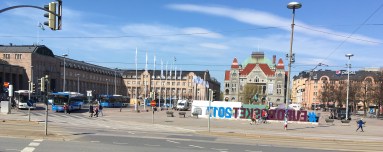
Helsinki RR Station from Ateneum

On my one full day in Helsinki, Friday the 19th, I elected to focus on one main objective, visiting the Ateneum art museum, located on the main square, Rautatientori, near the old, hulking central RR station.  The tram from “my” neighborhood stopped on the square, so wandering was minimized.  The museum, part of the Finnish National Gallery organization, was featuring a large homage to “Alvar Aalto, Art and the Modern Form.”  It also featured a longer-running exhibit entitled “Stories of Finnish Art,” displaying the extensive holdings of the Ateneum, both national and international, covering works from the nineteenth and twentieth centuries.

Aalvar Aalto, born at the end of the nineteenth century and working in the twentieth century until his death in 1976, was a dynamic polymath who refused to stick to his core skills in architecture and design.  He and his wife, Aino Marsio, as professional partners were initially influenced by classic architecture in Italy, but grew to be leaders of the “modernist” and “functional” design movements of the twentieth century.  He helped oversee the striking design of the Finnish Pavilion at the 1939 New York World’s Fair, whose undulating wooden wall Aalto compared with the Northern Lights.  Working on the total environment of buildings they designed, Aino and Aalvar oversaw not only outer structure but lighting, furniture, and textiles within their buildings.  They were also friends of and collaborators with artists Fernand Leger and Alexander Calder, a few of whose works are also on display in this tribute.

Reaching my limit of absorbing new information, I moved more rapidly through the Ateneum’s other collections.  It was fascinating, though, to follow the evolution of Finnish art through the 1800’s and into the cultural and political upheavals of the 1900’s,  through realistic depictions of the native Finnish countryside to abstract and symbolist paintings influenced by Parisian and Roman movements.  Here I first learned, through visual depictions, of the ancient oral epic of the Kalevala, a Finnish and Karelian equivalent of the Iliad or Beowulf.  How few Americans are aware of this work, so central to Finland’s sense of national identity.

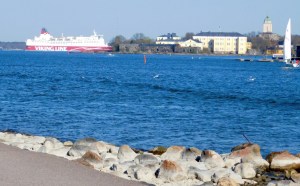
Mid-afternoon, I stepped out into the sunlight on the square, and walked about in search of a cafe with a view of the bustle.  Given the chill air, I enjoyed a seafood soup at a rough wooden table looking out on a terrace full of students enjoying the sunlight.  I then followed my feet back to the tram to carry me “home” to the Ulanlinna apartment and the seaside promenade.  Approaching late afternoon on a Friday, a large cafe and terrace along the seaside was filling up with young professionals celebrating the end of a work week and the late arrival of warm sunshine.  The tables were soon covered with wine and beer glasses wrapped in laughter.  I climbed the steep hill in the center of the Kaivopuisto park, and captured this image of a ferry headed south into the Gulf of Finland and the Baltic beyond.  I was excited to see a vessel like I would board the following morning.

Ferry in Gulf of Finland
View from promenade near Laivanvarustajankatu

Encounters in Stockholm

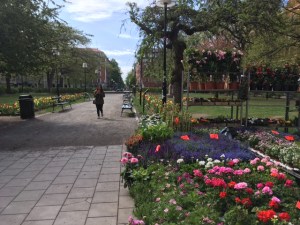
Mariatorget, Maria’s Park

Tuesday evening, May 16, I arrived in Stockholm after a restful five hours on a high-speed train hurtling across the Swedish countryside. The fields were just beginning to be green and yellow with planted crops; I stared and the fields and woods and compact farmhouses.  Did I really just land in Europe the day before?  From Stockholm’s central station I found the correct commuter subway to carry me to the neighborhood of Mariaberget, including the charming Mariatorget, a park and square in the Sodermalm district, to locate my next bedroom in a private home.  The quiet neighborhood is a few minutes’ ride south from central Stockholm, and the apartment building is a few blocks hike from the Mariatorget subway – “tunnelbana” – station.  Ah, but again, the last blocks involve climbing up a steep rock-cobbled lane to an obscure sidestreet;  and again, multiple conversations with strangers to locate the spot.

A historical note:  this park was constructed in the 18th century and originally named after King Adolphus Frederik, but renamed in the mid-20th century after the nearby Kyrka (Church) of Maria Magdalena.

I was met at door, just off the cobbled lane, by an older lady hobbling on an aluminum cane.  In much detail, she carefully showed me around her modest apartment; the entry opened into her kitchen, with steep stairs leading from there to the bathroom, and a shorter set of stairs leading to her (sunken?) living room and an adjoining bedroom.  The bedroom was mine; I slowly put it together that when guest occupied the bedroom, the host slept on the sofa in the living room, and the guest needed to walk past her and up the stairs and then down a steep stairway to use the bathroom.  Oh my.  When you are my advanced age, access to the bathroom in the night is a matter of critical logistics.

My host recounted to me the reason for her struggles with walking:  she had a hip-replacement done, and the artificial ball had popped out of its socket twice already in about a month.  She had an appointment soon to evaluate the need for changing the hardware.  I shared that I also had hip replacement surgery a couple years past; happily, mine had not failed.

After briefly but gladly placing my bags in the bedroom, and with detailed and repeated instructions on use of the dual locks on the heavy entrance door, I headed out into the cool evening to search for a restaurant and roam the environs. In May, daylight begins at 4AM and lasts until about 10PM at this latitude, allowing long night-time walks in clear and pale light. The main road in the area is Hornsgatan, and it is lined with cafes and restaurants.  I landed in one, and enjoyed a fine pasta; I learned throughout Scandinavia that it was much more likely to find sushi, kebab, pizza and pasta restaurants than one serving “typical” Swedish or Finnish or Estonian dishes.

My first mission on the next day, Wednesday, was to buy the necessary adapter for my charger plugs to work in Scandinavia; my phone and tablet were dying.  With the help of my apartment host, I located a little electronics store on Hornsgatan that sold the correct instrument.  When reviewing the printed receipt, I laughed and remarked upon the inclusion of 25% sales tax.  When the storekeeper learned that sales tax was generally between five and seven percent in the USA, he first remarked: “I should move to America, I could sell so much more with only seven percent sales tax.”  But then his eyes widened with realization:  “But you have to pay for medical care, and education, don’t you?”

I acknowledged the cost of medical care, but did not correct him about our public education.  I pictured all the private schools, often “Christian,” where the wealthy class in the USA sent their children, but chose not to get in that discussion with this happy storekeeper.  I was ready to wander the streets of central Stockholm.

Mansion on Stockholm islet
Stromsborg, Stockholm

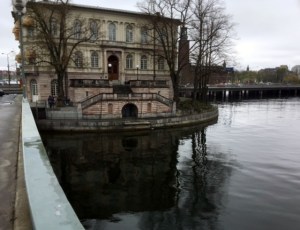
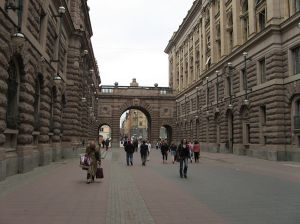
My bedroom host had urged me to visit the “Vasa Museum,” featuring a reconstructed 17th-century sailing ship housed on the island of Djurgarden.  But, from the T-bana station in central Stockholm, my feet carried me across one of the many bridges to the island of Gamla Stan, the original “old town” of Stockholm.  I stared at the massive Royal Palace and the ornate Swedish Parliament buildings, but was not greatly moved to tour those heavy stone monuments to state power past and present.  Walking over one of Stockholm’s many bridges – the city is built on 14 islands – I was fascinated with a massive stone mansion on a small nearby island.  It is called Stromsborg, apparently built by a wealthy merchant in the 18th century.  It currently houses the offices of IDEA, an international institute to promote democratic elections.

After wandering through Gamla Stan then over bridges to Djurgarden, a park-filled island, I finally encountered the Vasa Museum, masts poking out of its roof.  But I was immediately put off by the flock of tour buses near the place, and was more fascinated by the massive dark building nearby, housing the Nordic Museum.  It seemed far less attended. But I chose to just wander the grounds and watch the people; the late afternoon was cool and gray, my feet were weary, and I headed back to the T-bana and Mariatorget.  As noted in a later blog, I returned in a few days to visit the Nordic.  Stopping by the apartment, my host, apparently a controlling person in her solitude, seemed very upset that I had not been inspired to tour the Vasa Museum.  “But it is the best place to get a sense of Sweden’s glorious maritime history!”  Chastised, I headed out for the clarity of the surrounding streets and the quiet solace of the same restaurant I had found the night before.  Mariaberget, for the moment, was my neighborhood; in the dying light, I found a cobbled walkway to a bluff overlooking the water and central Stockholm.

Scribbling my end-of-day notes in the moleskine journal, I mused on the ability of the traveler to capture intuitions about national and cultural cultures, through brief and random encounters.  I surmised that, being alert for signals in a strange place, you may be more receptive and perceptive when first exposed to the lives of others.  You are on alert, watching the myriad details of movements and gestures; this watchfulness may fade with habitual exposure.  I brashly meditated on the character differences of Danes and Swedes, and their shared trait of living in affluent welfare states while seeming to honor the royal traditions of ancient monarchies.  A fan of Henning Mankel’s work, I saw more social anxiety among the Swedes. There did seem to be more ragged homeless folk on Stockholm streets.  As a healthy older male, I pondered the prevalence of tall, proud and pale-skinned women in all Scandinavian countries; that required no deep intuition.

Thursday morning, May 18, was planned as a travel day: subway and bus to the airport for a short flight to Helsinki.  But a nasty surprise awaited.  Near 7 AM, I was awakened in my Mariaberget bedroom by moans and yelps of OY-OY-OY, lasting for several minutes, then a pause, then the same sounds again.  I lay there for several moments, clearing my head, trying to understand what was happening.  Finally I leapt up and headed toward the door to the living room (my host’s bedroom when guests were present), fearing what I would encounter on the other side.

I quickly determined that the poor lady’s artifical hip joint had come undone, again, and she was frozen in a half-standing half-crouching stance, resting all of her weight on one leg and two crutches that she gripped fiercely.  Ironically, as she had explained the previous evening, she had a morning appointment with a different surgeon to assess the need to replace the joint.  We managed to reach the emergency service and call for an ambulance; she seemed to have a lengthy conversation in Swedish with the operator about her situation and location.  The wait for the ambulance felt like 30 to 45 minutes; in the meantime, my poor host directed me to perform a long list of tasks: wiping the ever-dripping sweat from her brow, adjusting her trembling grip on the crutches, fetching a variety of items to pack in a small bag for the hospital stay.  The lady is a detailed planner, even in dire straits.  She also had me help her take some meds, three small capsules in a foil sheet.  I think it was an over-the-counter pain suppressant.

At last the ambulance arrived on the cobbled street below our lane — they could not directly pull up in front of our entrance but had to climb some concrete steps — and two ladies climbed out, looking around.  I stepped out the front door and led them into the apartment.  I then assisted the rescue women, for what seemed like another hour, to maneuver my host onto a stretcher and up and out and down to the ambulance.  Ampules of morphine were administered, and slow, small movements were required in order not to hurt her more.  Meanwhile my host, through all the pain and sweat, kept firing off instructions to the very capable ladies and to me; she wanted to be sure I closed up the house correctly.  The rescuers and I silently rolled our eyes at each other, acknowledging the endless instructions.  When my poor ‘landlady’ was finally rolled onto the ambulance, she wept uncontrollably, with a combination of frustration, pain, and embarrassment.  She who needed control had lost it all.

I selfishly enjoyed the silence and calm in the house as I prepared my self and my bags to leave the apartment and lock it up as my host instructed.  Walking toward the subway station, through Maria’s Park, I breathed deeply and thankfully.  The placid picture of flowers in Mariatorget, at the head of this chapter, was taken that morning as I left.

City of Islands
On Bridge to GamlaStan
Parliament in Old Town, Stockholm
Riksgatan, GamlaStan

Five Days, Four Countries, Four Homes

On May 20, 2017, I landed by ferry in Tallinn, Estonia, following one night in Copenhagen, and two nights each in Stockholm and Helsinki. Each stop was a high-speed snapshot colored by rented room or apartment, as well as by the random encounters with kind, helpful Europeans.

Central Railroad Station, Copenhagen
Copenhagen Central Station

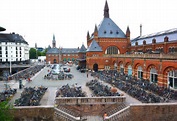
Five days earlier, Monday May 15, I landed in Copenhagen at 7AM (1AM on my body clock),  following little sleep for two nights.  The transfer by train to Central Station and the five-block hike to the AirBnb apartment was without incident, except for the bleary wandering of a stranger to find the street named Victoriagade where my apartment building stood.  My asking for directions was hampered by my inability to pronounce the street name.  I was put off by the rough trade wandering the rundown neighborhood (what did I expect, so near the RR station?), but was pleased to finally encounter my host/owner’s assistant at the locked entrance.

I was early; I hoped only to leave my roller bag while wandering the city until check-in time.  I quickly learned that roller bags are tough to wrangle on those rough cobble-stoned streets that tourists consider quaint, and tough to lug up the steep staircases of old apartment buildings.  My burly Danish hostess was initially annoyed to see me so early, but grew more hospitable after I returned from a couple of hours of languishing in a nearby cafe.  Ah the cafes, where the price of an espresso and perhaps a toasted ciabatta secures a table by the window and free wireless without time limit.

First impressions of Kobenhavn:  the residents are open, helpful, and meticulous, pausing generously to give the wandering foreigner directions – in impeccable English.  You are more likely to run into a traffic jam of fast-moving bicycles than one of noisy automobiles.  The urban landscape of this city, and much of Scandinavia, seems dominated by massive but colorful stone buildings, generally four or five stories high (I recall this feature in Amsterdam as well).  The structures seem to more defend against the outside than to open interiors to the clear pale northern light; though, once inside, I realize the windows – and frequent skylights – are strategically-placed to capture that precious sunlight.  The heavy stone walls – capped by steep, often mansard, roofs – guard the inhabitants from the enduring chill of long winters and the monotony of a few long summer days.  I develop an hypothesis about the Danish culture:  the people have survived as a tiny vulnerable country by trading fairly, peacefully and openly with most other nations, maintaining Copenhagen as an open entrepot.

Rosenborg Castle

At the end of a full day of wandering the central city, including the Kings Garden – Denmark is a Kingdom as well as a welfare state – I stumbled in jet lag stupor to a plaza filled with open-air markets and cafes, and gratefully settled on a bench with a seafood salad.  An American settled next to me, and shared that he was on a bicycle tour and had been biking in the Danish countryside all day.  He asked me what he should see in Copenhagen the next day; naturally I provided him my expert recommendations following a few hours’ of walking. I encouraged him to walk in the royal gardens, with the Rosenborg Castle as a centerpiece.  The castle was built under the direction of King Christian IV, in the 17th century.  I did not recommend the famed Tivoli Gardens; they resembled a run-down amusement park.

After the uneventful one-night stopover at that Victoriagade lodging, I traveled on to Sweden (by rail), then Finland (by air), then Estonia (by ferry), lugging that roller bag and heavy backpack around to four different households in five days; not the ideal way to explore new lands.  I justified it then, and now, by two stories I tell myself:  that my main goal was to experience Estonia, and that I was coming back through Stockholm and Copenhagen for two nights each after Estonia.  We shall see how that played out.

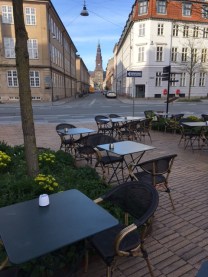
One of my favorite photos from that first day in Denmark, with the Town Hall tower reaching for the evening sky:       

Fact Richer than Fantasy


Friday eve 12 March in my quiet home, after delivering Sammie the rescue cat to his caregiver, I blogged a plan for the launch of my Scandinavia/Estonia (ScanEst?) journey:  Fly to Washington- Dulles Airport on Sat 13; meet my son coming from State College and join DC college friends for dinner;  after leisurely hotel stopover, bid son goodby and check in for Sunday evening flight over North Atlantic to Kobenhavn.

Not to be:  I woke up early Saturday with a throbbing molar, and envisioned the unraveling of my intricate travel plan.  I was terrified by the image of a pain-drenched 8-hour flight and 16 days in four European capitals seeking emergency dental care instead of absorbing the life and lights of Scandinavia.   I began down the dark hallway of imagining an attempt to re-book reservations made over months. Oh the dreadful cost.

In a state of controlled panic, I called and connected with the weekend emergency stand-in for my usual dentist. As he listened and commented, a new light shone on my dilemma: take antibiotics, temporarily control the likely infection, buy a reprieve from the agony.

The plan unfolded:  the drugs called in and taken, the Saturday flight rebooked to a 6AM Sunday departure, the balance of the journey salvaged.  As I languished on a gray rainy Saturday, head foggy from anti-b’s, aspirin and Tylenol, I understood:  I risked a relapse of a raging tooth and gum while tramping my ancestral lands of Northern Europe.

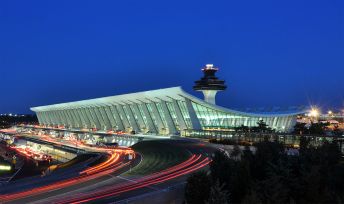
But I rode through the 4AM misty NC gloom to take that brief flight to Dulles,  then to wander all day in the cavernous terminal and board the Europe flight on blind faith.   In my hours of weary wandering the now-tarnished terminal, I marveled at the multi-colored Babel of the species swirling  in that temple of flight.  All of us clamor to be transported to a different place.  I was able to spend an hour or so with those friends, heading to Ireland the same evening, that I had hoped to see the night before in DC.   As I finally board the SAS flight to Europe, disappointment about changed plans melts away, and the tooth pain subsides.  As I  cruise above the North Atlantic, I lean on the Spirit to carry me East one more time.

So now that the first important step in my ScanEst expedition concludes – with imminent landing at Kobenhavn – I am reminded that travel plans like financial budgets are cloudy dreams until they hit the tarmac.  I did want out of my comfort zone, right?

Guide Me to the Launchpad

The luck of the traveler, or spirit-guide, has led me to a nicer sendoff on my journey than I expected.  I travel from home in North Carolina by flying to Dulles International on Saturday 13th May, to stay overnight at a local hotel to wait for my nonstop flight to Europe on Sunday eve.  I had expected I would be alone in my thoughts and prayers on Saturday evening, perhaps tossing and turning as my body anticipates the long journey.

BUT, serendipity colludes with family and friends:  my son Shep is eager to join me on Saturday eve and Sunday morn, making the 3.5 hour drive to help send me off.  Then, with little hope of making a connection, I text a dear old friend from college days, still living in DC with his bride of many years.  First surprise:  they are in town and available to dine with me and my son, though they always seem to be off on their own journeys.  Second:  they are (coincidentally?) flying to Ireland on Sunday evening from the same international concourse at Dulles.  My friend Steve is the master of knowing the right restaurants for such impromptu gatherings, and Shep and I will meet them at Spices on Connecticut Avenue in NW DC.

CALLOO CALLAY!  HOORAH HOORAY!  This joining of people promises to generate much divine energy to impel our respective journeys.  I have not seen Steve and his wife for several years.  They last saw my son Shep when he was about five or six years old, when we visited their DC home from ours in New Jersey.  Little Shep could barely clamber up the steep wooden stairs to the third-floor guest room.  Now he towers over us, brave and bold as a former Marine and current civil engineer.  Shep is husband to Nurse Morgan, and father to Great Baby Sophie.  I have not seen my granddaughter S since November, when she was a mere month old.

I will look forward to seeing her in late June: that will be my next journey after returning from Estonia, Sweden, etc.