
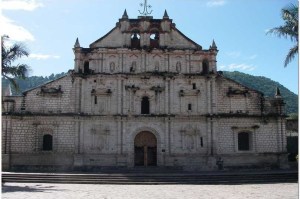
To date, I have not blogged about a future trip. My plans to visit Guatemala in June, 2018, inspire me to share those plans.
In past decades, I have traveled for business and pleasure in Mexico and most of Latin America. I advanced my Spanish language ability while living in Ecuador with my young family. As a retiree, I sharpened the dulled language synapses in Costa Rica and Spain. I continue to use the Spanish language while I tutor immigrants in English in Asheville, NC. So I pray that I will be able to absorb the nuances of the Guatemalteca form of Spanish – flavored by the robust indigenous Amerindian dialects. Perhaps I will pick up a phrase or two of K’iche’, Q’eqchi’, or Kaqchikel.
I will be travelling with a group of nineteen North Americans, led by David LaMotte and Sarah Bryan of PEG Partners, Inc. PEG is the Spanish-language acronym for the Guatemalan School Project (Proyecto para las Escuelas Guatemaltecas). David and his wife Deanna founded PEG in 2004, and have built it slowly with small donations since then. The initial motive was to help rural villages build simple schoolhouses, since the central government was not providing funds for such structures. PEG has expanded to assist with books and with a music program. You can find more information at their website, PEG Partners.
When Guatemala is mentioned, many people in the U.S. and Europe think of Mayan ruins and violent rebellions. What they may not understand is the centuries of crushing oppression of the indigenous Amerindians, los indios, by the European and North American invaders. As in most of Mesoamerica and South America, a small elite of mestizo (or “ladino“) and European descendants control the welfare of the mass population of various Mayan and non-Mayan indigenous folk. European or Yankee owners relied on ladino overseers to manage the slave-like labor of indios on coffee and sugar plantations. The relation of indigenous indios with the ladino class has been rife with racism and cultural chauvinism for centuries, although in the twentieth century some campesino – peasant – movements, like CUC, have allied with poorer ladinos.
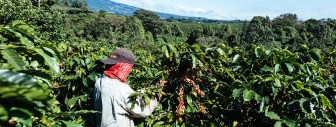
The Federal government of the USA has repeatedly intervened in the affairs of the people of Guatemala, often in partnership with corporations that have benefited from the slave-like worker conditions. Most infamous of the U.S. interventions was the overthrow of democratically-elected President Arbenz in 1954. As the schools supported by PEG are mostly in simple rural villages, they are populated by the indigenous people of the earth. They have quietly, persistently conserved their pre-Columbian view of the world, in a syncretic mixture of native and Christian practices.
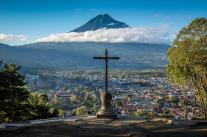
I will fly to Guatemala City a few days before the group gathers there, and will proceed alone to the old colonial town of Antigua. Originally named Santiago de los Caballeros (St. James of the Knights), it was the first permanent seat of government for the Spanish colonial empire of Central America, covering what are now the nations of Costa Rica, Honduras, Nicaragua, El Salvador, Belize, the province of Chiapas (Mexico), as well as Guatemala. Soon after the founding of this capital, both the Franciscan and Jesuit orders established their schools and residences in the town. Repeated earthquakes over the centuries destroyed most of the original structures, and finally the capital was moved to the site of Guatemala City (GC). But earthquake-shattered ruins of ancient Spanish baroque facades remain, some reconstructed and partially-destroyed multiple times.
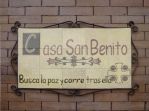
When the PEG group arrives, we will first gather at the Casa San Benito in GC, and will visit two organizations providing assistance in Guatemala, CEDEPCA and UPAVIM, with website links of cedepca and upavim. The latter organization centers on empowering women and is supported by the sale of fair-trade craft products. The former, supported by U.S. faith communities, sends missions to Guatemala for medical and dental assistance. Folks at CEDEPCA will help provide our group an introduction to the history and condition of the country.
We will next travel to El Tejar, a village where the music-centered school of CEDIN is based. CEDIN is the Spanish acronym for the Center for Holistic Education and Development, affiliated with Child Aid. The programs there are jointly supported by PEG and by LEAF International. According to the PEG website, “In 2012, LEAF International, which is a non-profit project of the Lake Eden Arts Festival in Asheville, North Carolina invited the older students from the school band to come to the United States to perform. Eight students, ages 11 to 18, and three adults (the two music teachers and the school principal) spent ten days in North Carolina, working as artists in residence at a middle school and performing at an elementary school in Asheville, then at Duke University in Durham.”
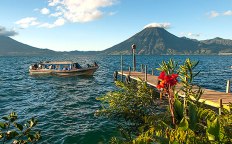
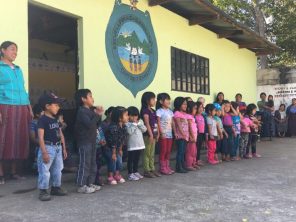
From El Tejar we will travel to Antigua, explore that town (again, for me), then to the village of Panajachel (“Pana”) on the shore of Lake Atitlan. After a hotel stay there, we travel by boat to Santiago, where we will stay La Posada de Santiago for two nights. During the intervening day, the group will travel to the village of Tzanchaj, home of the Escuelita David LaMotte. We expect to help with a work project while at the school, as well as to sing and read with the students. According to the PEG website, “Though the school is officially named after PEG founder David LaMotte, it is known locally as ‘Nino’s school.’ It is one of several schools that participate in a Traveling Book Box program, also supported by PEG, which operates from the Biblioteca Puerta Abierta (Open Door Library) in nearby Santiago, Atítlan. Teachers at this school and others in the area also recently benefited from another project supported by PEG, a teacher training seminar on classroom management and encouraging critical thought.”
I will return to GC, for the flight home, after the stay in Santiago. I hope to carry back visions and notes of the schoolchildren of rural Guatemala, to share on this site this summer. I fully expect that my travel spirit guide will find me on the road.
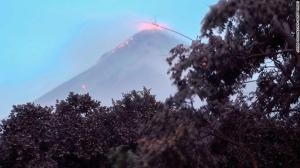
NOTE: following the original posting of this page, the Fuego Volcano in central Guatemala erupted with a destructive “pyroclastic” flow burying nearby village homes, with mounting deaths. Rescue and cleanup efforts are ongoing, and there is some risk of additional eruptions. Our group leaders still hope we can travel there, but with a modified itinerary and purpose. Perhaps we can be of assistance to those thousands affected. (Posted on June 5, 2018.)
 Following the Spirit
What a beautiful and enriching journey coming up–I look forward to hearing more about your travels, experiences, and service in Guatemala. May the spirit cover you in safety, grace, and peace throughout your trip.
LikeLike
Thanks. traveler spirit just guided me home from visit to PA with young Hoehling family.
LikeLike