

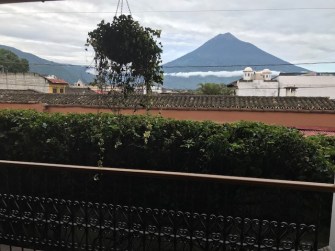
After all the finely crafted plans for about ten days in Guatemala (see my previous post), nature took over and rendered a shorter and more challenging voyage. But then, this is the country that has confounded all travelers since a band of smelly, rugged Spanish soldiers marched into the land in the early sixteenth century, aided by bands of indigenous warriors recruited along the way from conquered Teotihuacan. The invading knights had another ally, the viruses they carried that felled far more Mayas than did their swords. I only visited a few of the planned sites, as tiny animalitos, little bugs, entered and frolicked in my core like a Mayan revenge. Then again, the conquering Spaniards, with their Church allies, kept establishing and moving their chosen capital as the earth shook their stone structures. They boldly named each chosen capital Santiago de los Caballeros de Guatemala, or the Knights of St. James, Guatemala chapter. I kept hoping for the animalitos to leave me alone, but persistent “eruptions” led me home early.
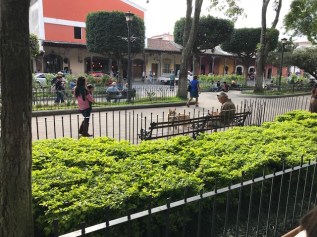
Following an on-time, smooth flight from Atlanta, I was met at the Guatemala City Airport and driven quickly (!) southwest of the capital to the older colonial town of Antigua. While the driver, Erwin, was courteous and responsible, he blithely accelerated up and down the sinuous road that mounts and descends the mountains that surround the capital, jogging my travel-weary stomach. But he brought me safely to the Casa Florencia, a pleasant and simple hotel in Antigua. Immediately setting out under the heavy wet skies of the rainy season, I walked the cobbled streets to the Parque Central and to buy a local phone. I had learned that morning, before boarding in Atlanta, that my daughter-in-law in Pennsylvania was about to give birth to her second daughter, a mere 20 months after their first. So I was eager to stay connected to home without spending too much on my domestic carrier’s international fees. So I settled into the Cafe Condesa to text my son for news.
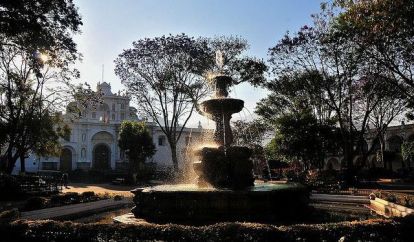
The layout of the Parque Central follows the design carried by the conquerers from most Spanish cities to the colonial towns of Central and South America: grand iglesia or catedral on one side, the government palace on another, and a baroque arcade along a third side filled with shops and cafes. You could say I had grown jaundiced about this ancient architecture, originally designed to impress the indigenous population and make the small band of conquerers comfortable in their strange surroundings. (Compare the Plaza Mayor in Salamanca Spain, and the Parque Central in Heredia, Costa Rica – both locations of great language schools I have attended.) But I enjoyed sitting in this Parque – or Plaza – sharing a bench with a young mother nursing her baby while watching her 3 or 4-year-old daughter feeding the pigeons. In the overcast mid-afternoon, scores of schoolchildren swirled and screamed around the central stone fountain.

After a fine Pepian Soup at the Casa de Sopas (I recommend), I rested uneasily in my hotel room while listening to the powerful thunder echoing against the surrounding mountains throughout the night. After an early breakfast at Casa de Mixtas (also recommended), I walked to the bus park and climbed onto a colorful “chicken bus” for the short ride to Ciudad Vieja. (These chicken buses are garishly-repainted old school buses, many produced by Thomas Built Buses of North Carolina – a former banking client of mine.) Ciudad Vieja is the site of one of the earliest attempted capital cities for the conquerers; while the knights moved on, monuments to their conquest remain in the central plaza. I trembled before the rough stone carving that celebrates the submission of indigenous tribes to the proud conquistadors. It emanates a heavy brutality that is normally lightened by standard baroque arches. As I stared at a plaque carved into the side of the central church, which honors Jorge de Alvarado as founder of Ciudad Vieja in 1527, I imagined the resentment of the indigenous residents of these symbols of bloody oppression. These stone memorials poke a collective thumb in the eyes of all the sturdy inheritors of the jungled earth.
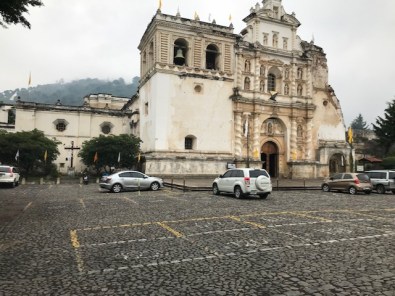
Such thoughts persisted as I rode a chicken bus back to the stone-filled tourist attraction of Antigua. Though my thighs were already aching from the morning’s exploration, I hiked across the town to the Iglesia of San Francisco, drawn by the stories of Pedro Hermano, the patron saint of this town. A poor Franciscan priest, he established the first hospital for the poor and homeless of the city, and is buried within this Church of St. Francis. In spite of the history of priests aiding the conquerers, Brother Peter is a light in the darkness. But as I trudged back toward the central park, in a persistent tropical drizzle, I noted block after block of empty, dark piles of ancient stones that were the ghosts of the passing Spanish glory. Designated a UNESCO “World Heritage Site,” all of these sprawling ruins are protected from redevelopment. I wearily wondered at the price of honoring that bloody past: all that wasted space while indigenous families in worn handwoven cloth sleep on the uneven stone walkways of the colonial palace. Imagine a global initiative to convert these “historic” heaps of stone into affordable housing and workshops for artisans.

I will not share the name of the restaurant I tried my second night in Antigua, as the following morning I awoke with the unpleasant impact of “Mayan Revenge,” the aforementioned-animalitos. Although weakened and unable to eat, I adhered to my schedule and rode back to Guatemala City, to stay at the lodging Casa San Benito that was the first resting place for the Peg Partners group due to arrive the following day. Briefly greeted by the group leaders, David LaMotte and Sarah Robinson, I flopped on the hard cot in my tiny room. But, driven by hope and a manic adherence to original plan, I ventured out by taxi to the National Museum of Archaeology and Ethnology (Museo Nacional de Arqueología y Etnología). While there is a wide collection of carved stones from Mayan ruins, and artfully-accomplished exhibits of the ethnology of the original inhabitants, the Museum suffers from deferred maintenance and gloomy lighting. The ladino politicians and landlords are not inspired to donate funds to honor the conquered indios.
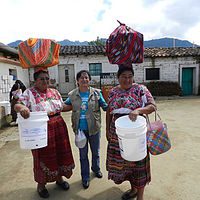
Weak and depleted, I rested in my small chamber for most of the following day, emerging in late afternoon to meet the nineteen-odd members of the Peg Partners group. The following morning, I mustered the energy to ride with the diverse group to its first introduction to Guatemala, at the offices of CEDEPCA, a Protestant-funded group (SEE https://www.cedepca.us/ ). Among its programs, CEDEPCA’s ministry to women through education, and disaster assistance, seem to have the most powerful impact. Framed in a Biblical context, the women’s education seeks to empower those caught in a culture of “machismo,” raising self-esteem and providing practical work skills. Most recently, this NGO has been providing ground-level disaster assistance to the victims of the eruption of Volcán Fuego, that buried whole families and villages. In addition to offering temporary shelter, CEDEPCA volunteers assist the emotional recovery of survivors. The keynote speaker to our group was a charismatic pastor, Hector Castaneda, who provided a sweeping view of Guatemalan history. Understanding of that history begins with the insight that the Spaniards came to Central America after fighting “Moors” for eight centuries, thereby, as Hector explained, developing “cruelty as a natural weapon.” Cruelty remains a core feature of governing; the conquerers came to grab wealth and return to buy glory at home, in the process raping the indigenous women as if they had no souls, and creating a class of ladinos to rule in their stead. American companies, backed by US military and intelligence, continued the economic rape of the country. It seems that the indigenous communities need emotional recovery from five centuries of oppression as well as from natural disasters. And the world wants to preserve the crumbling stone monuments to commemorate that history?
That NGO meeting was the end-point of my Guatemalan journey. My illness persisted, and the following morning I realized I could not continue with the group as they headed out to visit the schools supported by Peg Partners (see http://pegpartners.org/ ). No visit to the music school, no rustic tourist lodging by the shores of Lago de Atitlan. I was able to rebook my return flights to Atlanta and Asheville for the following day, after several hours of struggle. I was referred to a fine and gentle doctor a block from my Casa, who loaded me up with the appropriate meds to combat the bugs. I flew home in a daze, not dwelling on the missed opportunities but contemplating the lessons learned. Perhaps my visions of what could replace the crumbled ruins was all I was meant to see on this journey. My travel spirit guide knows better than I. And I look forward to meeting my latest granddaughter Lennox Rosemary. Maybe she and her sister can one day pursue that vision.
NOTE: I want to share some marvelous Spanish dichos, or sayings, that are written on the wall of that Antigua restaurant I will not name; the owner claims that they have been offered by various customers. Enjoy.
“Delibera con caútela, pero obra con decisión;
Cede con gracia, y aponte con firmeza.”
“El amor es como los cinco panes y los dos peces,
No comienza a multiplicarse hasta que tú lo ofrescas.”
“No pierdes el tiempo.
De esa materia, está hecha su vida.”
These lose too much in translation; work on it.
 Following the Spirit
what a wonderful journey through history you have taken us. The history of the conqueror that plagues this whole continent and much of the rest of the world. when will we ever learn. love your style.
LikeLike
A brilliant recap of your shortened journey, and great lessons from history. Hope you are completely recovered, and get to meet Lennox very soon!
LikeLiked by 1 person
thanks; visiting in PA in couple of weeks, overlapping with Annaliese. Kaethe there this week.
LikeLike